Out of the depths, o Lord

The news that Charlie Kirk had been shot, and the subsequent update that the injury was fatal, cast a gloom over much of the western world on Wednesday night. Like many, I prayed that he would survive, but it was not to be.

So, did the God in whom he so unswervingly believed fail Charlie? That is what the crowing mobs – and, sickeningly, yes, there are such people – would tell you. They are always there, in every disappointment, every terminal diagnosis, every loss, every bereavement, jabbing their fingers and asking, ‘where is your God now’?

He is closer to the broken hearted than any atheist would believe. Indeed, closer than any Christian who has not yet been broken can comprehend. The late Queen, quoting indirectly from Dr Colin Murray Parkes, famously said that ‘grief is the price we pay for love , but I would add – from my own experience, no less – that God’s comfort is the dividend of faith. I have no doubt that the believing family and friends of Charlie Kirk are experiencing that God, and that comfort more viscerally now than ever in their lives before.

‘Pain’, said CS Lewis, ‘is God’s megaphone to rouse a deaf world’, and so maybe this personal, human tragedy for Charlie’s family should be regarded as a wake-up call to the rest of us. The political responses have been predictable: hunt down the person responsible and deal with him as punitively as the law allows; suppress the far left: in short, meet violence and lack of understanding with more violence and lack of understanding.

This is not the way. Any hopelessness that I feel in the face of this tragedy does not stem from a questioning of God, but of the depressingly unchanging way in which people are responding. Yes, it may be possible to locate the gunman . . . and then what? Does dealing with what may be an act of unwarranted inhumanity from someone ideologically opposed to Charlie Kirk end the problem? Of course it does not. The world’s way, as we are seeing daily, is to meet brutality with brutality. We talk more than ever before about understanding, about kindness, and about walking a mile in the other guy’s shoes – but I don’t think this world has ever contained less comprehension of love than it does at this moment.

There is, of course, a way through; there is always a way through if we are prepared to humble ourselves. Therein lies the rub, however. We have made gods of ourselves, of our desires, of our feelings. Nothing must be allowed to hurt me, or even contradict me. If you doubt my word, or dare to pose a counterargument, you are not merely disagreeing, but hating. In their populist stupidity, successive governments have tried to legislate for petted lips, for offended sensibilities, and now stand amidst the wreckage, wondering who to blame.

Blame us, then, the creatures who have tried in vain to usurp our Creator. We did this. Our relentless pursuit of power and glory has wreaked interminable havoc. Ultimately, we tried to run this world on a rogue operating system, having tried every which way to disable the pre-installed software. And we have catastrophically failed.

That, atheists, is why people die in pointless wars and human conflict, and why every day is peppered with innumerable acts of cruelty and depravity, inflicted on one set of human beings by another. It is the reason why, no matter how well-intentioned we think we are, nothing goes to plan. And when – if – the person whose bullet killed Charlie Kirk is found, we still won’t be satisfied. Don’t look for justice in a world that no longer recognises truth, that no longer cares whether a person or an act is good or evil, as long as it aligns with their own world view. We, each of us, think of ourselves as the plumbline for everything: does it sit true against my ideology? No? Ah well, it must be wrong.

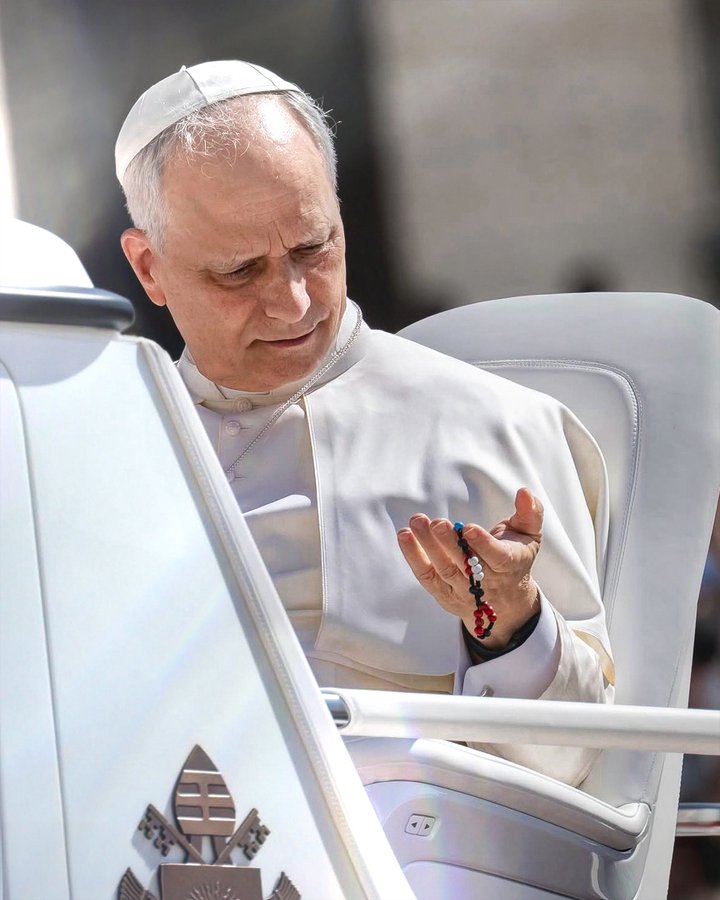
This is no nihilistic assessment of world affairs. It is a call, not to arms, but to peace. I was so moved by the words of Pope Leo (yes, Proddies, him again) earlier in the week in describing the role of tears in situations such as this one. Weeping is not a sign of weakness, but of strength; Christ cried out on the cross to his Father, and that type of anguished plea can be understood, the Pontiff said, ‘as an extreme form of prayer’.

Sometimes, love has no other outlet than to shed tears. I think we have now reached that point as a world. Cry, then, from the depth of your hearts, to the God of all comfort, because he understand us – better, even, I think – without words. 

Popes, Presbyterians and Piety

I have long been a connoisseur of quality bodaich and despite my upbringing and cultural leanings, it was somewhat inevitable that I should add the new Pope to my collection. It’s stretching the definition a little to include a sprightly fellow in his late sixties, particularly when it had been considered that his ‘youth’ might work against him in the conclave. Nonetheless, I’m counting him in.
Now, what is it, you may well ask, that appeals to a Leòdhasach of Calvinist leanings about the head of the Roman Catholic church? Please don’t write in, but here it is: his faith. I mean, yes, he’s photogenic and highly entertaining with his high-fiving, pizza-scoffing, baseball-signing ways. Nuns squeal with delight in his presence, and he has been gifted a truly sensational number of hats and cuddly toys, signalling a general acceptance that he is a cutie pie of the squishiest kind. And yes, I am well aware that this is not quite how the Westminster Confession of Faith refers to him.
But, here’s the crux. If we are Christians, ultimately we are only concerned with one thing: the increase of the Kingdom. Aren’t we? Doctrine has its place, of course, but when you see people who profess Christianity – Protestant or Catholic – wielding points of doctrine and even of liturgy and tradition as a means to gatekeep salvation . . . well, I am reminded of the good sense of God that he didn’t leave it in our hands.
I mean, I have thought for years what a shame it is on us that an island like Lewis hosts so many different (but not) denominations. You can’t get an onion-skin page of your Bible between any two of them in matters of doctrine and confession, but they have put supreme effort into locating even one difference that mandates them to sit in a separate, three-quarters empty building. Never mind that we do not have enough preachers, never mind that increasingly elderly congregations are burdened with heating and lighting churches across the island when we could probably all fit into one or two.
And if our hearts were fixed upon the love and joy of the Lord, that’s exactly what would happen. We’ve all read the revivalist accounts, where people couldn’t bear to be parted from one another, so continued praising God into the wee hours.
Now, we not only put up walls, but we form whole new denominations to show just how wrong those others are. Not us, obviously. We all think we’re worshipping the right way. It started off with eschewing the bells, smells and statues of the Catholic Church. And since then we have divided and subdivided so many times that we’ve now resorted to separating over what kinds of songs are sung in praise of God.
Chan ann san aon àite a tha an olc. This is not just a Calvinist thing. Since finding myself on the RC side of social media (this happens when you follow the Pope’s every move like a fangirl) I have read an awful lot of self-righteous nonsense from Catholics too – only the priest should hold his palms upwards when praying, the Eucharist should be placed directly on the tongue and not into the hands . . . Mo chreach, with all the petty bickering about the correct way to worship, I’m inclined to think that we have more in common than we might care to admit.
Which is my point here. There is one Redeemer, and he is the one route to Heaven. When he comes back to claim his church, I don’t think he’s going to sift us by denomination. Call me bold, but I don’t even think he’s going to ask us which songs we used to praise him, how we held our hands, and if we used beads, prayer cards, or candles. Faithful women who went hatless are probably not going to be counted less than hard-hearted ones who covered their heads.
Unless I have been on a very misleading path all this time, it is not about any of the trappings. God gave us something that is, yes, undoubtedly, mysterious, and in many ways beyond our comprehension. But, more importantly, he gave us something so simple that a child can understand it; indeed, he said that WE must become like children to receive it. Not by squabbling over ritual, and certainly not by telling each other we’re damned because of the way we stand, or kneel, or wear our hair.
No, we must receive his free gift as he offers it. Complicating it is a sin because it may act as a stumbling block to someone else. What is wrong with us when we tell others that they cannot be saved because they have a statue of Mary, or because they allow musical instruments in their churches? Shouldn’t we be saying, ‘never mind HOW you worship, as long as your worship is of him, and for him’? Why aren’t we hungry and desperate to share our loaves and fishes with a multitude?
Yesterday, I watched Pope Leo preside over Mass with a group of people, described in the Vatican briefing as ‘the poor’. The Pontiff urged us to make no difference in our hearts, or in our dealings, between those who minister to people in need, and the needy themselves. Each, he said, meets Christ in the other.
Perhaps I am naïve. There’s a good chance this blog will be taken as further evidence that women are silly about doctrine and definitely shouldn’t have a voice in their churches. Nonetheless, in a world that is buffeted by the enemy, I think we should focus more on being Christlike – as the Pope has modelled throughout his life – saying little, but being and doing what we ought, witnessing effectively in faith. I prefer the white martyrdom of Leo XIV to the whited sepulchres that would damn us all on a technicality.

Keep A Thing Seven Years

There’s a Gaelic saying which suggests that if you keep a thing for seven years, a use will be found for it. Sometimes, though, it doesn’t take that long.

This Sunday, I will have kept my grief for seven years. Like many new possessions, I carried it with me everywhere for the first while, moving it around as self-consciously as a child walking in stiff, leather shoes. When it was worn in a little, I started to forget for minutes at a time, only to be assailed by the reality of it when I least expected. In the last few days of Donnie’s life, I had been painfully aware that some time very soon I would no longer be a wife, but a widow.

I didn’t like the word and still less the idea that it represented.

Yet, in seven years, I have been taught to wear the mantle with something approaching acceptance. Instead of being allowed to push the garment from me, God has gently shown me that it IS mine to put on, every day. Traditionally, it also took seven years to train a piper, before they would be allowed to perform in front of an audience. There was no such apprenticeship for me, though – just straight in at the deep end.

I often think how this might all have been, had but one thing been different.

These seven years would have seen me grow bitter, perhaps, or reckless. I might have spent my time in wishing my husband back, or wishing I’d never met him – anything, in short, to remove the excruciating pain. The memory of his suffering could have tormented me to who knows what depths of anguish.

The one thing, though, which saved me from all of that was the hand on my shoulder. It wasn’t simply Christ saying, ‘I’m here, you can lean on me’. That would have been wonderful enough. In fact, his message was subtly different. He was actually telling me, ‘Remember I’m here. You know what to do’. This wasn’t the beginning of a wonderful new relationship, but a life-changing development of one that I hadn’t truly known I was in.

While I have carried – and will carry – Donnie in my heart, it is not loss which dominates my reflections over these seven years without him. It is gratitude. I had such a marriage that I didn’t think I could live without him. But God used that blessing to show me a much deeper and more enduring love. He has fulfilled me in the years of my widowhood, and shown me that, in Christ, all situations are an opportunity to know blessing.

I have profited from his teaching. It goes without saying that I have benefitted in more ways than I can count from his love and mercy. From the very beginning of this journey, though, God has laid it on my heart to share my providence with you. He did that, and then he made it possible.

Most miraculous of all, he took what might have destroyed me and blessed it to the extent that I can say that the Lord gives more than he takes away. Last Sunday, our minister used the sermon time to remind us of the glory and holiness of this God. And, right at the end, that devastatingly beautiful flourish of truth: ‘Remember, though, he is also your Father’.

Glorious, holy, perfect – of course; but tender and loving to the last. Not ‘also in our hard providences’ but especially. If you don’t believe it, I will take you to see a man who told me all things I ever did, and loved me just the same.

The Compassion of the Christ

Today was a communion like no other. The old traditions had all been peeled away, and only the essentials remained: the bread, the wine, the table, and a gathering of God’s believing people.

It was enough.

And the words that called to mind the loneliness of Christ’s suffering could not have been more apt for such a time as this. Many of us have gone through a protracted period of aloneness over the last two years. Families and friends have been separated, people have met death without loved ones to hold their hands. I cannot imagine what it must be like to have been bereaved during the pandemic, especially in communities which normally show their support by drawing alongside those who mourn. Who could forget those images of our newly-widowed monarch, sitting quite alone in St George’s Chapel? In that moment, she symbolised the loneliness of many across the nation.

Yet, she cannot feel your grief or mine, anymore than we can experience hers. For that, there is none but Christ.

Not only is he acquainted with grief, he has borne the unimaginable loneliness of being cut off from God. He chose to take that into his own experience in order that he might obliterate it from ours. Listening to the minister today, speaking of the peculiar loneliness of the Saviour on the cross, I was reminded of Derick Thomson’s poem, in which he speaks of peeling back the Lewis sky to behold:

‘the Creator sitting in full view of His people
eating potatoes and herring,
with no man to whom He can say grace’.

No man to whom he can say grace. No man to have compassion upon him in his pain. No man he can send.

Even in my more cynical or despairing moments, when I think there is no one to whom I can turn for advice, no one I can trust . . . there is. In these two years, during which I have been much alone, I have not been lonely. There are friends, there is family – but better than any of those, there is Christ. His advice never fails, his presence never departs; he has plumbed the depths of his own loneliness and so he is the soul of compassion in ours.

We are a society in sad need of compassion. I see a strange set of parallel phenomena creeping in. The more we say, ‘be kind’, the less able we seem to be able to apply that – as Christ does – to everyone. There is a drive to stand with victims of all kinds, which is as it should be. More understanding and not less can only be a positive development. But, are we unable, or simply unwilling, to offer a second chance to people who have gone wrong? Our world sends some into the wilderness forever, guilty of unforgivable falls from grace in our eyes.

That’s not how Christ deals with anyone. It’s not how he dealt with me; it’s not the example he set his followers.

He hung on a cross and endured the ultimate loneliness, to an extent we cannot begin to understand, in order to save us. To take that legacy of love to ourselves, we have to imitate him – he has always known the very worst and darkest details of our hearts, yet never abandoned us. Accepting his gift means sharing it abroad.

Sharing it abroad, means peeling back to the essentials as symbolised in those elements today. The death of Christ accomplished our salvation, but not so that we would keep it to ourselves.

My Heart Will Go On

A few years ago, I was asked to write my testimony for the church newsletter. I began by saying, ‘The Lord’s presence in my life is something of which I have been aware for almost as long as I can remember’. It was a conscious decision to begin, not with me, but with him, and to end the article in much the same way. This was not merely stylistically important, but a deliberate avoidance of what Sir Humphrey Appleby called ‘the perpendicular pronoun’. Our coming to faith is never about us per se, but about the miraculous goodness of God, who saves in spite – and not because – of who and what we are.

Testimony is not a static thing, however: it grows and develops as we persevere in the life of Christian discipleship. I think, for that reason, it’s important that we should go on testifying to the power of Christ to save, every day of our lives.

I am spending this advent in reading John’s gospel. It is a slightly unusual choice because, of course, this book doesn’t deal with the birth of Christ; instead, John starts at the real beginning of everything. 

And, fittingly, chapter 1 presents us with the testimony of John the Baptist. He tells who Jesus is, presenting him as the Son of God, and humbling himself as a mere witness to the glory of Christ. John makes himself recede into the background of the story, so that our eyes are not on him, but on the Saviour. On Friday, I attended the funeral of an elderly Christian lady, known for the brightness of her faith. In a lovely and personal service, the minister paid tribute to her, and then added that he was conscious that she herself would not want to be eulogised; but rather prefer that he should spend the time in talking about Jesus.

In that moment, I understood fleetingly what is meant by ‘irresistible grace’. It was hard to believe that anyone listening to this beautiful and moving testimony to faith could harden their hearts against the attraction of Christ. 

And I fell in love with him all over again. 

This is why Christian testimony cannot remain the same: the richness of our relationship with Christ is such that we are discovering new depths to it all the time.

If I had to distil what I’ve learned since writing that first testimony down to two things, I think I would start by saying how practical a thing faith is. It isn’t an idea, a concept, or that most threadbare of things – a comfort blanket. Christianity is a faith to live by, or it is a delusion.

And it is not a delusion because belonging to Christ and following him, however imperfectly, will set you free. I know. Believe me, I know.

The second thing I’ve learned is that no one else has a right to comment on your relationship with God. People will have ‘rules’ they think you should be following, and draw their own conclusions when you don’t measure up. It’s not about them, though. They won’t be there to dry the tears of hurt their thoughtless words provoke . . . but Christ will, always, so fix your eyes on him. Make his the only good opinion you seek and never mind the naysayers.

He is the author and finisher of our faith. Stick with him and he’ll see you through, not merely to the end, but forever.

Sabbath Fury

We have had a lot to say about the Sabbath here in Lewis – so much so that Luke 6 actually makes uncomfortable reading. 

Jesus is rebuked for permitting his disciples to pluck grain to assuage their hunger. Later in the passage he offends the Pharisees again by healing a man with a withered hand who is in the synagogue on the Sabbath.

Many thought the Sabbath twice broken by Jesus because he permitted the hungry to be fed and caused a disabled man to be healed. Jesus himself, of course, saw things differently.  As a man in this world, he didn’t concern himself with outward conformity; and as our intercessor in heaven, he is just the same.

The Lord sees us in ways we cannot see each other. He knows our hearts and our needs – and he knows our motives.

Was it love for Jesus that moved the Pharisees to keep the Sabbath?  Perhaps. But ask another question: was it love for Jesus that made them enforce it so rigidly on behalf of others?

We have our answer at verse 11, ‘But they were filled with fury and discussed with one another what they might do to Jesus’.

Nothing that fills us with fury is good. It edges out the love that ought to dwell in the hearts of all Christians. Sabbath-keeping, to my mind, is one outward sign of love for the Lord: we keep it because we are glad to do so. But it is not, in itself, loving him. In fact, this chapter shows us that it is possible to adhere to the outward so rigidly that we can remove Jesus from the throne of our hearts.

Spoiler alert: at no point in the following 18 chapters will Jesus demonstrate his care of the people through Sabbath-keeping. That is a desire that comes from a changed heart: it comes from within; it is not imposed from without.

We have to be so careful as Christians because we cannot see others as our Lord does, from the inside out. It is a challenge, then, not to punish the unchanged hearts for lack of conformity and lose the privilege of truly witnessing in the process.

Let us find where Jesus harangues the lost for breaking the Sabbath, and then we can emulate his example.

And the prisoners heard

Sunday afternoon sunshine lured me outside to sit on my recently-painted decking to read, write and contemplate. There were birds singing in the trees and lambs bleating in the croft beyond, but not a sound other than that to pierce the stillness. I had recently risen from morning worship with my congregation, and was in exactly the right frame of mind for a bit of contemplation.

I was also filled with an enormous sense of wellbeing. These are days filled with uncertainty, trepidation and, for many, grief. None of us knows when it may be our turn to walk through the valley of the shadow of death. Yet, we know that God is with us, and that ,while a shadow may well encroach, it can never devour.

So, while the world’s media is talking in terms of a global crisis, of catastrophe and lockdown, God is enabling me – and many more besides, I think – to experience this as the day of small things which we are warned not to despise.  As I sat in the warmth of this early spring day, I thought about the week just gone by, and the ways in which I have met with Christ in the long hours of solitude.

There is his word, of course, and prayer. These are constants. Normally, though, they are the launchpad for what Lady Bracknell disparagingly referred to as ‘a life crowded with incident’.

I am rediscovering my inner introvert, however. This week, I have  delivered a number of lectures and tutorials, spoken on the radio about my favourite Scottish novels, attended a meeting of the Stornoway Trust, and participated in a whisky tasting – all without budging from my dining table. In between, I walk, cook, clean, read and write. In the evenings, I chat to friends and family, listen to music, and catch up on television programmes, films and podcasts that I’ve missed.

Friday was glorious. I finished classes, and took the dog for a long ramble on the machair. Confusedly dressed in wellies, linen trousers and a cashmere hoody (I like to acknowledge all seasons in one outfit), I got spectacularly rained on. Showered and pyjama-clad, I lit the wood burner and laid out my various samples of Jura whisky and wild water from the Stornoway Trust Estate in time for the Instagram tasting event.

It was not, I am quite certain, the 46.7% ABV 21-year-old malt that gave me the feeling of complete serenity, but the sense that this was a day of privileges, dispensed by the hand of a gracious God. He has enabled me to continue doing my job, and fulfill other obligations while remaining safe and not feeling isolated in the least.

Discussing this with a Christian friend on Sunday evening, she said that she was concerned by the number of people – believing people – who are not doing so well. She hears from folk who say that lockdown is beginning to pall on them, who say they miss the human interaction of church. These are by no means all people who live alone either.

All of which set me wondering what’s wrong with me that, six weekends in, I am still only able to see the positives.

I have come to a number of conclusions. Ultimately, I don’t go to church for the social aspect. In fact, quietly and without anyone else noticing, I ceased attending organised fellowships of any kind more than a year ago. Church has been a place of worship for me, and that continues to be possible by God’s grace through the technology which it is our privilege to access and enjoy. Yes, there are people whose society I miss, and I will be glad to see them when we are once more able to share a pew. Until then, however, I am getting the essential parts of the church experience at home.

Like many others, I am gratified by the way in which being a church quite literally without walls has enabled new people to join us for worship. An open door may theoretically be welcoming, but there is still a threshold to cross which can seem like a journey of a thousand miles to the stranger. Online worship presents no such barrier.

A lot of Christians are invoking the image of Israel’s captivity to describe where we are at. I don’t disparage other people’s feelings or experiences, however, when I say that this is not my view of things at all.

Christ has freed his people, and we do him no justice if we consider ourselves captive still. We ought to be like Paul and Silas who sang and prayed in their cell at midnight. The walls could not contain them because their hearts were fixed upon worshipping God. He was there with them, he is here in my house too; and he is with all his people wherever they are. Ask the suffering and persecuted church if you can’t believe a Wee Free woman.

My favourite part of that account, though, is the following four words: ‘and the prisoners heard’.

Those who are still enslaved, not by government lockdown, but the bonds of sin – what is our witness to them? Perhaps he has brought us out of our comfortable churches into the information super-highway so that they will hear us, not weeping and complaining, but lifting up our voices in praise of the Christ who will never leave nor forsake us.

No Sting in this Tale

Everyone is looking back. It is not just the turn of the year, but the close of a decade also. Photos abound, comparing faces from ten years ago with their present-day counterparts; and there are the inevitable lists – what we wanted to achieve over against what actually transpired.

If I do the same, the change in my life looks seismic. At the start of this decade, both my father and husband were still living. I was quietly going about my business: work and home and family were the boundaries of my small world. My face was considerably less wrinkled, my eyes less baggy, and that generally shopworn look had not yet settled on me. It was still possible to stay up all night at election counts and do a full day’s work afterwards. In short, I hadn’t started to think I might be mortal.

That all changed when we experienced a break in our tight family circle. With the death of my father came the real, heart realisation that this world is not forever. I felt that some door to eternity had been flung open and I lived in a state bordering on terror that death was not yet done with us.

It wasn’t. Yet, when it came again to claim Donnie, I was so blessed to be able to see it as what it really is: the last enemy.

I had heard the term, of course, many times – which death-fixated Calvinist has not? But I hadn’t properly understood that such a gloomy phrase could convey much spiritual comfort.

See, as an unassured Christian, I took it to mean that we all need to accept the fact that there is always that last hurdle at the end of our lives. No matter, I thought, how easy or difficult things are in this world, no matter whether you are atheist or believer, there is this dragon guarding the exit. It was a lurking, crouching, dark form, waiting to blight my life by removing loved ones and, eventually, to claim me too.

‘Well’, you’re thinking by now, ‘am I glad I started to read this – she’s fairly cheered me up. A blog by PTL is like the last enemy at the threshold of the year!’

I refer you to Naomi’s advice for her daughter in-law, Ruth; advice I often have to give myself: ‘Wait, my daughter, until you learn how the matter turns out’.

I haven’t finished yet.

Death being the last enemy is not a threat to me anymore; it’s a promise. You may say that this is all very well because, yes, it is the ‘last’. Nonetheless, it is also still the ‘enemy’ and that is something, surely, to fear.

It used to be. That’s why my father’s death left me feeling persistently exposed and vulnerable. Eternity was speaking to me, laying before me two options. There was the broad road, which looks so easy and attractive. Parallel to it was the narrow path, winding, steep and – in places – dark. Standing at the entrance to these it seems simple to pick which journey to take.

If I had chosen to be seduced onto the broad way, I would be facing the last enemy alone. Instead, by God’s infinite mercy and grace, I was drawn down the narrow way. It isn’t straightforward and I have stumbled so often. There are even many days when I look wistfully at that parallel track, and even stand on the verge that separates the two, wondering where I belong.

The last enemy waits for me, some way ahead – near or far, I can’t be sure.

But, because I walk, limp, and crawl in the company of Christ, the knowledge that death is the last enemy is a sweet one. It doesn’t loom ominously because my wonderful Saviour vanquished it for me long ago:

‘I fear no foe, with Thee at hand to bless; Ills have no weight, and tears no bitterness.

Where is death’s sting? Where, grave, thy victory?

I triumph still if thou abide with me.’

So, yes, on the surface, and even somewhat deeper, this has been a hard decade. Over the last year, indeed, and even the past fortnight, there have been many attempts by the devil to make me fear, so that I will regret the way I have taken. It is difficult to hold your nerve against such onslaught- which is why I don’t; I give it to someone else to hold for me.

The bags under my eyes, the tired face . . .  don’t be fooled; inwardly, I – like every man or woman who calls upon the name of Jesus – am being renewed.

At the start of a new year and a new decade, then, I pray for that perspective on the last enemy to be the lot of those I love. More challenging still, I pray that it will also be the lot of those of you who hate me for Christ’s sake.

The Offensive Truth

It’s all getting a little bit boring. I mean, irony is all very well in its place, but I have had it with reading what the so-called ‘progressives’ in our society have to say about the sincerely-held beliefs of Christians. They talk about tolerance, and they talk about everyone being free to do what they want, and believe what they want . . . but they just can’t shut up about it for one minute, can they? For people who don’t believe in God, they sure love talking about him. Any and every chance they get, those so-called unbelievers are tweaking the nose of the Almighty.

Now, if they were here (and I suspect that some of them may be), they would tell you that they find Christian beliefs so laughable that they cannot permit our childish fantasies to inform or influence public life and policy. Or – and I actually saw this from someone on social media last week in response to local decision making in Lewis – they will say that they cannot permit Christians to bully the rest of society into following a lifestyle that society has rejected.

I have a few issues with this. First of all, there is the arrogance inherent in judging my beliefs when you do not share them. Every believer has had the patronising, ‘comfort blanket’ remarks lobbed at them. Indeed, if that were all my faith amounted to, it would be an inadequate covering in times of trouble, and atheists would be justified in mocking. But it is much more. Would that the ‘progressives’ would use their much vaunted reason to consider the possibility that Christians have experienced something that they have not. If I have come to a different conclusion about God, then perhaps it is because I have seen evidence that you have – thus far – not.

Secondly, and I apologise for repeating this yet again, my holding of a different worldview does not make me a demagogue. Last year, while pretending to be reasonable, the local branch of Secularists Anonymous repeatedly invited me for coffee via Facebook, so that they could ‘explain why secularism is no threat to your faith’. I didn’t accept their disingenuous offer because, amongst other things, I already knew that their secularism was no threat to anything I believe. My hope is pinned upon something immovable and unchanging. Only the most arrogant person could think a Christian would feel threatened by their puny doctrine.

By the same token, however, should unbelievers not realise that my having different views to them is no threat – particularly if they are right and I have the intellectual capability of a small child, believing in a non-existent God? Yet, here in Lewis and further afield too, Christians get accused of bullying for . . ? Well, for adhering to the principles of their faith.

We skirt around this sometimes because it’s difficult, and because I’m afraid there are some branches of Christianity which have allowed the world, and even its own followers to exist on a mistaken interpretation of the phrase, ‘God is love’.

Yes, he is: God IS love. That means that he is the very definition of it, the template for it, and the yardstick by which all other manifestations of love are measured. While he is love, God is also truth. God is the blueprint for all that is right. And he is the ultimate in grace, in holiness, in perfection.

That’s who I am – inadequately – trying to follow. If you haven’t seen him for who he is yet, you cannot know what I know, or see him as I do. He showed me who I was and where I was headed and you know, Christ did me the greatest favour of all by being the very opposite to what the world asks.

If he had been the kind of Saviour our society has tried to build for itself, he would have showed me myself, and he would have said, ‘that’s you, with all your flaws and the blackness of sin – but I accept you that way, because it’s part of your identity, and it’s fine’.  Christ would have told me that if I was happy in the way I was living my life (and I was), and as long as I didn’t purposely hurt others, he’d take me at face value.

That’s not what he does, though. He couldn’t. Society is a mirror that has taught us to say that we can be whatever we want as long as our intentions are good. But it has taken away the gauge by which we measure what ‘good’ means. No wonder we’re adrift, seeking answers in our own flawed wisdom.

Christ, on the other hand, shows us what we are in comparison to him, in light of what he is and what he has achieved for us. I have seen myself time and again, measured against his perfection and found badly wanting. Yet, I have also seen his free offer of the grace that will mould me in his image in the fullness, not of time, but of eternity.

This Christ doesn’t want me to be a bully. It was not how he persuaded people to follow him, and it is not how he would have his church behave. You cannot impose salvation or the freedom of identity in Jesus upon people who are wilfully blind. I cannot make those who have not seen themselves in his light understand that I am not brainwashed, nor enslaved – but committed to following him as faithfully as I can.

That means I will believe things that seem hurtful to them, because they don’t yet realise that, while a lie comes in many editions, the truth only ever had one. We can reinterpret the facts to suit our own narrative, we can deny them a voice, and pretend that they do not exist – but in the heart of every believer, the truth burns as an everlasting and immutable flame.

I’m sorrier than I can say if shortcomings in me, or the church to which I belong have caused people to believe that there is a softer version of Christianity that permits people to live just as they please, to exercise the power of life or death based on convenience, or to write large tranches of the Bible off as irrelevant.

There is no such Christianity. One Christ and one truth – these are all we have. Once we have them, though, we come to realise that they are all we need.


Tolerance is Not an Option

The Scottish Government is considering a change to hate crime legislation in this country. That they are consulting extensively on it up and down this land – even in extremist Stornoway – is surely an encouraging sign. I wasn’t able to attend the consultation, being one of those subjugated Wee free women, but I have every faith that the Men in Black would have filed into the town hall, banged the table, shouted ‘Kenneth Street says “no”!’ a good few times, and generally held up the stereotype to which our national (and sometimes local) media so loves resorting.

Knowing my place (the kitchen) does not, however, prevent me from having concerns about the proposed overhaul of laws relating to – in particular – hate speech. While I wholeheartedly agree that such behaviour has no place in a civilised society, I worry that lowering the threshold on what constitutes, for example, hostile language, will criminalise people who are actually motivated by love.

Not two weeks ago, I saw someone, commenting on a Facebook thread, in which she was outraged at a minister saying that we are all sinners. She denied her own claim to that title, saying that she had never done anything wrong in her life. A remarkable paragon, indeed, but a sadly mistaken one.

Being a sinner is not like being an organ donor, or a contributor to your employer’s pension scheme: there is no opt-out. Read Genesis 3 – it’s all in there. Nor is it anything to do with whether you remember your mother’s birthday and hold the door open for old ladies. I have never murdered anyone, nor stolen from them, nor plotted the overthrow of a legitimate authority (unless you count the Kirk Session); but I am a sinner.

It’s important that this exercise fully takes on board the fears that Christians have, because we already know where the wilful misunderstanding and hostility of other people can lead. Before any individual, or government makes the grand claim that they are tolerant of Christianity, I think they should be aware of the challenges with which it will present them.

‘Tolerance’, originates from the Latin ‘to bear’ or ‘to endure’. However, it has become a word much associated with our liberal, anything goes society. People ‘tolerate’ what they cannot approve. You can say with impunity that there is no God, that those who believe in Him are fools (or bigots); and you can rewrite His rules – so what if He created them male and female, there is no gender. In fact, so what if He said ‘you must not kill’; we have the means to terminate life in the womb and if that life is going to inconvenience someone by seeing the light of day . . . well, it’s intolerant of anyone to try saving it.

You see, I don’t think that you can ‘tolerate’ the Christian faith. It is founded upon a Man who is a polarising force – you are with Him, or against Him; you are lost, or you accept salvation; you belong with the sheep or the goats; you are bundled as chaff and burned, or taken safely into His storehouse as wheat.

Christ will not allow us to tolerate Him. And when I say ‘Him’, I mean that to include His Church. Those of us who love Him and follow Him, and have founded all our hopes upon Him . . . we are members of His body. Strike at us, and it is actually His wounds which bleed.

If you change the law of this land so that a minister preaching the Gospel faithfully can be accused of using hate speech simply because you don’t being called a sinner, you are placing many souls in jeopardy. He is a Christian, called by God to spread the saving truth, because faith comes by hearing. Stop his mouth and you are building a dam against rivers of living water. It is not the preacher of the Gospel you offend, but Christ, who IS the Gospel. You are keeping the lifeboat at bay for yourself, certainly, but you are preventing others from climbing on board as well.

On a personal level, I fear what this kind of legislation might mean for my blog. In the past, writing on attempts to change the Lewis Sunday, I was accused of stirring up hatred, bitterness, and even racism. I examined my own heart, and I scoured what was written, but nowhere could I find what offended the unbelievers.

What offends them, of course, is love. The preachers of tolerance claim to embrace all kinds of love. But they do not actually see the only love worth having when it is held out to them. Believe me, I understand: there was a time when I couldn’t see it either.

And this is where the whole edifice stands or falls. Christ is calling to every one of us to either take His side . . . or move aside.

A ‘tolerant’ society does not understand that the Gospel was made to be offensive. It does what our government, our society and – increasingly – even our churches – will not do: it calls us out on our bad conduct. But we live in a world where words like ‘good’ or ‘bad’ have virtually been excised from public discourse. We are wise in our own sight, and we have turned away from God.

Regardless of what laws a godless country might pass, followers of Christ know what they must do. I don’t want to be tolerated; I want to be heard when I say to people dead in sin as I once was:

‘Come, see a man who told me all I ever did. Can this be the Christ?’

He requires of you an answer. As CS Lewis said, ‘Love Him or hate him, Jesus forces that choice upon you’.

Tolerance is not an option.