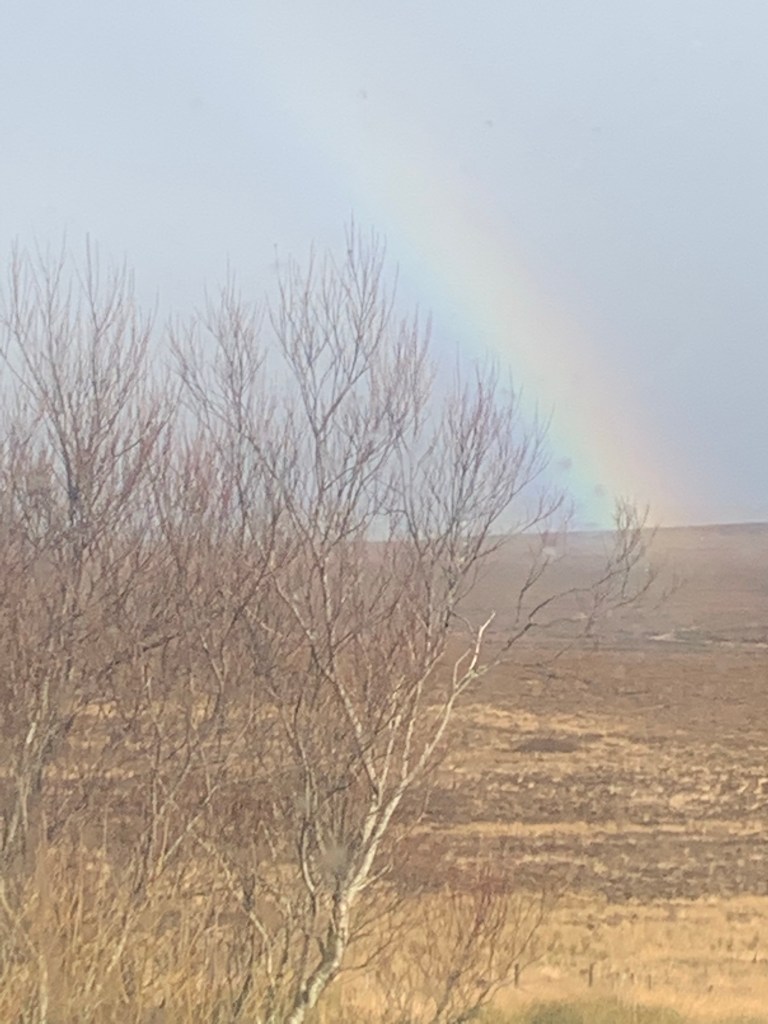
And I bought a field

‘Faith is not a leap in the dark’, the minister told us on Sunday and, if we were not buttoned-up Calvinists, that whole congregation would have been on its feet, yelling ‘amen’, ‘hallelujah’, and punching the air. The tiny dancer in my heart was certainly giving it yee-hah, as it does every time my soul recognises fellow feeling and fellow experience among the brethren. Our man at the lectern was voicing, surely, what we would all wish the unbelievers to understand. This is not some fairy story, a pleasant fiction to comfort the bereaved, or to anchor those cast adrift from all reason.

And do you know why? Because people suffering that depth of anguish cannot be placated with soft words and pretty lies. It takes a life-changing God to be sufficient in a life-changing situation. Whether it’s illness, or grief, the breakdown of a relationship, or the loss of a job – whatever it is, only a fool would suggest that a fable might meet our needs. I know that some of my atheist friends thought that’s what had happened to me; that I had reached out for my nursery God when I found myself in the valley of the shadow of death.

Aside from the inherent blasphemy, it was an insult to my grief to suggest it is so small a thing that I could tell myself a story to make it all better. That is what you get with the myriad creeds and cults that try to fill the spiritual void in the heart of every human being, but that is not what you get with Christ. And I don’t write these things because I want you to see that I’m right, that I’m not some kind of gullible dupe. In fact, I write about it because I really, earnestly wish that you would want it too.

The particular act of faith under discussion on Sunday was that of Jeremiah who, despite the unpromising circumstances, did as he was bidden by the Lord, and bought a field. Those acres were his testament of trust in God, that the exile would end and that better days were indeed coming.

I have also bought a field. The living God has contended with me all my life, and never washed his hands of me , despite the myriad reasons I give him every day. He would not let me perish, determined though I was to have my own way. And so, when grief came into my experience, he was not arbitrarily hurting me. Of course I don’t understand why the plan had to unfold like that – but I do know that it was necessary, and done to perfection. Faith has taught me that acceptance of this is easier when we trust in God’s purpose; and it is impossible not to trust in his purpose once we know himself.

Going forward in faith is not groping blindly, it is being led by someone in whom you can have complete confidence. Indeed, someone who wants better for you than you ever sought on your own behalf.

The time of pandemic has been a test of many things, but for God’s people, I think it has spoken necessary truths. I hear often that it has fostered a spirit of backsliding in some, which is desperately sad. For me, I feel it has renewed my faith. Throughout lockdown I spent many hours alone. During that first glorious spring and summer, I walked every day, witnessing the Creator’s work, and hearing his voice in everything that surrounded me. On Sundays, through the miracle of technology – which we have by his grace – it was possible for those who are united in the Spirit to share worship. Even more astounding, he added to our number as those who could not join previously began to listen, hungry for the word of God.

These are days in which I do not despise the small things: the tang of the sea, the lilting cry of a distant curlew, the quiet morning time of prayer, and the evening peace for writing in my journal. God is here with me – he fills my mind, because I have sufficient stillness to be able to think of him, to talk to him throughout the day. And I have faith, here in this field of mine, that the renewal I am experiencing is not mine alone. It witnesses to the fact that God is active in the lives of those who belong to him, and that those who are his but do not yet realise aren’t being forgotten.

In the perfection of his own will, and in his own time, he is bringing them in, He is persuading them to purchase their fields.

Life does not look as it did in 2019, and I think it never will again. That doesn’t matter, however. If we are founding our lives on the rock that is Christ, and if the Spirit unites us in worship and a desire to witness for the Kingdom, who are we to question the means by which this is achieved? My life and my home were changed beyond all recognition in God’s providence. But he has turned this humble, grief-blighted building into a place where I can experience the fulness of his love as long as I trust in him, and accept his will for me.

I am only one Christian, but I am a microcosm of the church. In all of this, we are not taking a leap in the dark; we are purchasing fields in the sure and certain knowledge that one day, our exile will end.
But it will be accomplished his way, and in his time.

Tempered Temper in the Temple

The account of Jesus turning the merchants and money-lenders out of the temple is a famous one, well-known even to those who would claim no regular acquaintance with the Bible. I suppose it seems to be at odds with our idea of him. In popular imagination he is either the Christ-child, gentle and meek, or he is the God-man, giving himself up uncomplainingly to the horrors of death. Those are both facets of his character, certainly, but they are not the whole person. His tour de force dealing with the agents of commerce in his Father’s house reveal an aspect of Christ that helps us understand him better.

There is a small incident in John’s telling of this story that drew my attention this week. Having taken a whip and driven the livestock out, along with their retailers, he commands the sellers of pigeons to remove the birds from the temple.

Picture the scene: he has scattered the coins, overturned the tables and personally expelled the merchants with their sheep and oxen. But the pigeon-sellers must take themselves and their wares out with no help from Jesus. What prevented him from sweeping their cages to the floor, or throwing them outside? Of course I don’t know, but I am inclined to believe that it was compassion. To rough-handle these gentle creatures would have been cruel and capricious – and, whatever people who don’t know him say, that is not in his nature. This is someone, in fact, so wholly consistent, so reliably in control of his responses, that he can direct and channel his wrath where it is deserved, and turn on a sixpence to show gentle consideration in the same moment.

His anger is not an emotion in the way that mine or yours might be. Sometimes we are controlled and directed by our feelings to a degree which can be destructive. Indeed, our forefathers believed that envy, for one, could be so powerful as to cause physical harm to the object of our desire, without us even knowing what we had done. That phenomenon – usually referred to as ‘the evil eye’ – is mentioned in a lengthy list in the Bible, alongside a whole host of other evils which are not external, but which actually emanate from within ourselves.

That’s quite a bitter pill for us to swallow – that we are not always the poor dupes of Satan, but more often than not, the willing perpetrators of badness ourselves. Our anger, our mean-spiritedness, our jealousy, our greed, our lust, our self-righteousness, our unconcern for others – that’s all on us. Satan just seeks to exploit the way we’re already inclined by nature.

What I like about this aspect of Christ is its realness. It demonstrates even further how completely I can trust him with my life. I have often been unjust to others, judging them harshly, expecting more of them than I should, and then feeling angry towards them when they fall short of my unrealistic demands. But he never has ‘a bad day’. When I go to him in prayer, he never casts up at me that I forgot him the day before when everything was going fine; he never grumbles that I do nothing for him, or retreats because he wants a little ‘me time’.

He is not a two-dimensional nursery god – Christ is multi-faceted, but not mercurial; he displays feeling, but is wholly consistent.

This is why people read Scripture: it is a means of seeing a little more clearly the beauty of Jesus Christ. And it is why, in a way, I prefer John for advent reading. The baby Jesus, whose life was in danger from the moment he was conceived, and the circumstances whose birth has become so culturally iconic as to be almost Disneyfied in the eyes of the world, he is easy to love. All babies are easy to love and none more so than the manger-child who gave us Christmas.

John presents us with something more challenging, though – he brings us Christ, who doesn’t lie helpless in a manger. He walks abroad and challenges those he meets with his very presence; and when it is necessary, he shows his wrath. Wrath to the defilers of his Father’s house, and gentleness to the helpless creatures who are guiltless of any wrong. I wish I had the wisdom to know the difference, and the self-control to treat them accordingly.

But, more than anything, this Advent, I’m grateful to know him a little better than I did last year. What an unparalleled feeling it is to be assured that there will never be any unpleasant surprises with Christ – that even his displays of anger are wholly justified, and trained precisely on the target.

My Heart Will Go On

A few years ago, I was asked to write my testimony for the church newsletter. I began by saying, ‘The Lord’s presence in my life is something of which I have been aware for almost as long as I can remember’. It was a conscious decision to begin, not with me, but with him, and to end the article in much the same way. This was not merely stylistically important, but a deliberate avoidance of what Sir Humphrey Appleby called ‘the perpendicular pronoun’. Our coming to faith is never about us per se, but about the miraculous goodness of God, who saves in spite – and not because – of who and what we are.

Testimony is not a static thing, however: it grows and develops as we persevere in the life of Christian discipleship. I think, for that reason, it’s important that we should go on testifying to the power of Christ to save, every day of our lives.

I am spending this advent in reading John’s gospel. It is a slightly unusual choice because, of course, this book doesn’t deal with the birth of Christ; instead, John starts at the real beginning of everything. 

And, fittingly, chapter 1 presents us with the testimony of John the Baptist. He tells who Jesus is, presenting him as the Son of God, and humbling himself as a mere witness to the glory of Christ. John makes himself recede into the background of the story, so that our eyes are not on him, but on the Saviour. On Friday, I attended the funeral of an elderly Christian lady, known for the brightness of her faith. In a lovely and personal service, the minister paid tribute to her, and then added that he was conscious that she herself would not want to be eulogised; but rather prefer that he should spend the time in talking about Jesus.

In that moment, I understood fleetingly what is meant by ‘irresistible grace’. It was hard to believe that anyone listening to this beautiful and moving testimony to faith could harden their hearts against the attraction of Christ. 

And I fell in love with him all over again. 

This is why Christian testimony cannot remain the same: the richness of our relationship with Christ is such that we are discovering new depths to it all the time.

If I had to distil what I’ve learned since writing that first testimony down to two things, I think I would start by saying how practical a thing faith is. It isn’t an idea, a concept, or that most threadbare of things – a comfort blanket. Christianity is a faith to live by, or it is a delusion.

And it is not a delusion because belonging to Christ and following him, however imperfectly, will set you free. I know. Believe me, I know.

The second thing I’ve learned is that no one else has a right to comment on your relationship with God. People will have ‘rules’ they think you should be following, and draw their own conclusions when you don’t measure up. It’s not about them, though. They won’t be there to dry the tears of hurt their thoughtless words provoke . . . but Christ will, always, so fix your eyes on him. Make his the only good opinion you seek and never mind the naysayers.

He is the author and finisher of our faith. Stick with him and he’ll see you through, not merely to the end, but forever.

Hope Springs Eternity

As I drove the forty miles or so to attend the funeral of my friend’s father in Ness, I thought about his wife – a lovely, warm and cheerful lady, and a sister in Christ. After all their years, and four children, together, she is now a widow. But how wonderful too, I thought, that she does not grieve as those who have no hope.

What does that actually mean, though? They are words often repeated at wakes and funerals, where the doubting, the unbelieving and the seekers gather alongside the saved. Even some who belong to Christ may never have stopped to consider the difference between Christian hope and the everyday, common or garden kind.

When my late husband was diagnosed with cancer, he underwent a battery of tests and scans. The consultant told us that all these were clear and therefore, he said, ‘there IS hope’. It didn’t impress Donnie who, a Lewisman through and through, interpreted it as a forlorn attempt to make the grim certainty of death a little less imminent. Hope, he argued, is all we have to cling onto when reality is a bit hard to take. And ‘hope’ seemed like a weak word in that moment, implying an outside chance at best.

We are often asked to prepare for the worst whilst hoping for the best and – again – this has trained us that hope is little more than a comfort blanket, and a thin one at that.

It was, as I’ve written before, at my own father’s funeral that I really began to understand the nature of Christian hope, and its difference from the common way. As a friend clasped my mother’s hand and told her, ‘he’s in the happy land’, I saw something in both these women that was much stronger than words: it was certainty. They had placed faith in so trustworthy a Saviour that there could be no doubting his promises. This was not a frail hope that the Gospel might just possibly be true, but a living reality, played out in front of me and anyone else whose eyes were open that day.

How strange it must seem to those as yet living in unbelief that death is often the place where Christians display the greatest hope. To those with no faith, the valley of the shadow is a desolate spot, a featureless wasteland where they must part forever with someone they have loved very much in life. That last clasp of hands, the dying breath . . . they are final. It is here in the valley that worldly hope perishes.

For the disciples, there was a time like this too, when the man they thought was the Saviour died, and their hope with him.

But even though they didn’t realise it, they were certainly not grieving as those who have no hope: they were grieving for a Saviour who accomplished so much more than they could have imagined. Jesus did not escape the cross because he did not want to merely cheat death; he embraced his punishment because he had promised to conquer death.

And conquer it he did.

We are asked to always be ready to give a defence of the reason for the hope that is in us. Well, I say you can do worse than look to the widows. 

My friend’s mother, my own mother and myself are all privileged to know the same thing, and to share in the same hope.

Death is indeed the final parting – because when we are reunited with those who have gone before us, it will be eternally and it will be in a better country – yes, even than Ness! This is not the hope offered by a kindly surgeon, but the security we can all enjoy in the Great Physician.

Keeping the Snail’s March

For me, Kate Forbes epitomises the challenge and the triumph of what it means to be a Christian with a public profile. The church rejoiced openly as she rose through the ranks of her party, trusted with increasingly heavy responsibilities. In our more reasonable moments we remembered to give thanks for her witness.

Sadly, our reasonable moments are all too rare and the reality is that Kate is much more likely to be attacked on questions of faith by fellow Christians than she ever is by the atheist community. For the most part, unbelievers think her faith is irrelevant and would sooner take issue with her nationalism or her fiscal policy. Or the fact that she’s a Teuch. But the brethren, oh, we don’t hold back in our carping. Although the complaints against her take many forms, they can be grouped together under the broad accusation – a perennial favourite of mine – ‘no Christian should support the SNP’. 

Leaving aside the fact that no Christian should be so flipping judgemental, let’s consider what might be behind this opinion. Because the Nationalists are in power and have been for so long, their policies are subject to prolonged public and media scrutiny. So, the opposition parties lurk in the shadows and let the ruling party take all the heat. Amongst all the finger pointing, few remember that those who stayed silent are complicit in wrongdoing as much as those who designed and built it.

A person would have to be either naïve or partisan to believe that the SNP is alone in its stance on the big ‘moral issues’ (which, bizarrely, never seem to include child poverty or homelessness). Let’s be honest, all mainstream parties have a broadly similar policy on gender, on marriage, on abortion, and on euthanasia. 

Why is that, though? Simply because they are the elected representatives of an unregenerate world. They do their secular best to create an environment of justice and social equality, quite divorced from the instruction manual. A Christian like Kate Forbes is all too well aware how doomed to failure such an endeavour is. No politician can save souls, not even if they imposed Biblical law on the nation entire. Obedience to God’s law cannot be the starting point for redemption because it grows from it – it is like expecting the flower without first supplying a seed. 

Besides, party politics is a numbers game. It is all about being in the majority – that’s how you get your views heard at branch level, and nationally. That’s how your party gets elected into power. Strategy, predicated on what the people want will bring you to the place where decisions are made. Remember, though, these are unregenerate people, for the most part, voting in a well-meaning way to get a better society for themselves, their children, and maybe even for those they see as downtrodden and exploited. They do not see Jesus as the way, far less the truth and the life; he, and his irksome followers actually stand between Scotland and progress.

And we prove them wrong . . . how? By turning on our own. We tell Christians in public life that they are falling short. Instead of giving genuine thanks to God that there are a few righteous among us prepared to be bruised and bloodied in the fray, we attack them for being part of a system that actually we all helped to create from the moment we fell. Kate Forbes can’t be a real Christian because she holds membership of a party that condones things that are unbiblical. 

This is an object lesson in shortening the arm of God. It presupposes any number of things – including that a politician cannot be called in the same way that ministers of religion are – and it seems to deny the possibility that human government is not the ultimate authority. 

People who never do anything make the mistake of thinking that they will never, therefore, do anything wrong. But, belonging – as we do – to a body whose mission statement begins with the imperative, ‘go’, stasis and torpor might actually be a greater affront than the occasional misstep. 

I have often avoided asking God his will for me, entirely because I fear his answer. He has had his way of inconveniencing me in the past, and I tremble to let him have that opportunity again. However, that is probably true in the experience of every believer – which is exactly why we should be more mindful of those who have answered his call. By ‘answered’ I don’t mean those who assume the mere appearance of vocation, but people who get their nose bloodied and their knees worn in the journey of obedience.

You pray for your minister and elders, I am sure. Such people report feeling a heightened awareness of God’s protection because of the prayer that surrounds them.

But there are other Christians who have been called and, because they don’t serve the institution we like to think of as ‘The Church’, we not only neglect to pray for them, but actually turn on them when – in our flawed opinion – they ‘fall short’. Spurgeon was well aware that some Christians were jealous of those who appeared to have done more for the cause than themselves; instead of redoubling their own efforts, they sought to drag the champions of faith back. Let’s not hold Kate accountable for the sinful ignorance of others, but let us uphold her in prayer for all the battles she has to fight.

Ultimately, they are our battles too.

Ministry of Offence

When I first started this blog, I felt like a very tiny speck of humanity, shouting out into the unknown from the middle of a vast wilderness. I didn’t represent any particular group, or enjoy the protection of an organisation- I was just a newly professed Christian, shooting her mouth off about salvation.

Then, though, a miraculous thing happened: the unknown whispered back.

Messages began to come from people I’d never met, saying that my writing encouraged them and how they could put their ‘amen’ to much of what I shared. Most unexpected of all, some even began to thank me for my ‘ministry’. 

I had never thought of myself as having such a thing. It’s not that I’m so narrow-minded as to think this is the sole dominion of coves in collars, not at all. Ministries, as I understood them, were the province of churches, and all those people you hear prayed for on Sundays. They’re the missionaries, the organisers, the bakers, the committee people – and they’re under the auspices and jurisdiction of their denomination or their Session. 

My blog doesn’t tick those boxes. I didn’t run it past the Men in Black, far less wait to be asked. If you wait to be asked, as a Wee Free woman, chances are you’ll be waiting forever. Well, I ain’t a waiting kind of gal.

And I’m kind of glad now that this is the case. Of course my blog is a ministry. It isn’t enough to be healed – you’ve got to tell people how it happened; and you have to be ready to defend the reason for that burning, bright, unquenchable hope that is in you. God led me to profess my secret faith with those messages, and he’s not going to let me re-cap my pen until the last ordained syllable has been laid down. 

No Session, no church committee, will ever give you that torch. Nor should we expect them to. Every Christian has it in them to be a minister for Christ . . . it’s just a question of how. 

Some people – myself included at times – thought it was mainly cheek a’ mhuncaidh that propelled me on. Again and again, I was asked where I’d found the courage to just speak, when no one had actually invited me to. It isn’t courage though, folks: it’s compulsion. I cannot shut up about Christ because . . . well, look what he’s done for me.

Time and time and time again I denied him. I knew he was there, but I fooled myself and others into believing I was doing it all by myself. Life was great because God had heaped blessings on my ungrateful head. And never – not once – did I say to him, ‘this is too much – give it to someone else’.

Not until the first day I thought I might lose my husband. Then, though, I considered God to be giving more than I deserved. He was exposing my brittle heart to the reality of death. So I cried out into the unknown, ‘how can I bear this’?

And a miracle happened: the unknown whispered back. Even more miraculous, it was not the unknown at all, but a dear and familiar presence that had been with me always, saying, ‘We will bear it. I will never leave you nor forsake you’.

This Jesus. That’s what our ministry is about. It’s not to tell people the answers, but to lead them safely to a Man who IS the answer. 

I may not carry a label that says ‘officially approved by the FCOS’, but written across my heart are these words: ‘redeemed by the blood of Christ; free indeed’. So, even although I don’t have a governing committee or a policy document, I’m going to stop cringing when you lovely people refer to Post Tenebras Lux as ‘ministry’ – it IS a ministry for Christ and it is my privilege to serve at his pleasure.

And if I’ve ever encouraged you in anything, let me encourage you in this: don’t wait for the ‘church’ to call you – get your mobilisation orders directly from its head. He has fewer rules about who can serve.

Every Breath You Take, Every Tear You Shed

Every move you make, every breath you take, I’ll be watching you. Unsettled? You should be. Imagine me turning up everywhere you go, keeping a weather eye on all your doings. Not anyone’s idea of a good time, least of all mine. Most of you are probably very boring, putting bins out and booking chiropodist appointments, not working for the secret service or dating celebrities on the Q.T.

Anyway, it’s just a quote from the song, ‘Every Breath You Take’, which has been jokingly renamed ‘the stalker’s anthem’ – and it popped into my head while sitting in church on Sunday morning. Now, before you all start fidgeting in your pews and eyeing one another nervously, don’t bother – it wasn’t any of you who prompted the thought; it was the minister. And, no, he needn’t be rushing out to get a bigger padlock for the manse gate either. It was actually something in the sermon that brought the song to mind:

God has a record of all our woes. The beautiful psalm 56 tells us that he stores up our tears in a flask. 

Now, I don’t know about you, but I’ve had some big sorrows in my life, the kind that feel as though they’re carved into my very heart. But every droplet that fell from my mourning eyes is numbered and bottled by God. He knows the depth and breadth of my grief in a way that even I do not.

Still more extraordinary, though, is the fact that he also has an exact record of the hurts that I’ve forgotten. I mean, I have cried over a lot of situations and a lot of people that long since passed into oblivion. There were emotional storms that seemed seismic at the time, but that I have certainly no word of now.

Yet my Heavenly Father remembers. Those tears are counted too. God is more tender towards me than I am towards myself.

And that is why, masked up and a metre from all my nearest neighbours, I added a couple more droplets to that eternal flask. These were not tears of pain, however. Relentlessly, psalm 56 unfolded in beauty, and I glimpsed – if only for a brief moment – the inexpressible heart of God.

You see, he not only collects the tangible record of our sorrow. In order to do this fully, he also follows us in all our wanderings. That is, he not only accompanies us on the journey we ought to take, but watches us when we stray from the path. 

Well, of course he does. A parent may smile at their child, safely sleeping in his own bed; but how much more watchful is that gaze when the little one is in danger? It was this that wrung the tears from my Sunday morning eyes – remembering all the foolish times I had tried to do things without him, never knowing that he was coming with me anyway, whether I acknowledged his presence or not.

The context for all of this is a familiar theme in the psalms – strength in the presence of the enemy. It asks the oft-repeated question, ‘what can man do to me’?

I have been afraid at times. Undoubtedly the most frightened I have ever been was when my husband fell ill with cancer. A few days ago, I overheard a television character being asked if he was afraid of something or other and he replied, ‘No. After my wife died, the worst had happened and so nothing else frightens me’. 

That is not how it is for me. When my husband died, before that, even, God caught me in his arms. He was more than sufficient in the worst fear I have ever endured. So, because of THAT- because of HIM – I cannot be properly afraid of anything else. I may get upset, I may be angry at the enemy, but I cannot fear him.

Sometimes in dealing with the onslaught against my faith, whatever form it takes, I forget to leave it with God. I get caught up with trying to tackle the situation myself, and I do so on my own (nonexistent) strength. 

It goes without saying that I make a hash of it. My repetitious tendencies in this regard have been a worry to myself.

Yet, there in church on Sunday morning in Stornoway, I felt a new surge of love and humble gratitude. One metre removed I may have been from my fellow worshippers, but my Father and I are never more than a hair’s breadth apart. Thanks entirely to him. He doesn’t permit that the stubbornness of my heart should lead me anywhere that he does not also go. 

So, why should I fear? Until the stopper is finally placed in the flask, and I reach the place of no more weeping, every move I make, every breath I take, he’ll be watching me. 

Now Only Three

On Sunday morning, I was driving through the neighbouring village of Gress. To my left, the carpark was already starting to fill up, and people were unloading an assortment of beach toys, dogs and children. Over to the right, the cemetery lay quietly, an eloquent reminder that even in the midst of life, we are in death. As I continued onwards, I fell to pondering what visitors make of our cemeteries, plentiful and prominent as they are.

In fact, like our primary schools and churches, the burial grounds are a testament to the way in which Lewis was grown. Each village was a world entire for the people who belonged to it. And note my use of language- it’s something those from outside of the islands would do well to take on board: we make no claim of ownership on these communities, but they have a claim on us. That’s why, to a degree, the concept of community ownership in the literal sense is a bit alien. Traditionally, our relationship with land has not been proprietorial.

Indeed, our relationships were always described in terms of claims on, and not by, us. Where do you belong to? Who do you belong to? 

Thus, the villages had their churches to nurture the spiritual lives of the people, and schools to educate. Land was tenanted, not possessed, and the whole patchwork stitched together by fellow feeling, common experience and mutual understanding. 

The cemeteries are a part of it. One of the first things I did as a grown-up, married woman was to pay the lair fees for myself, my husband and my mother in-law. I began life in Tolsta paying nine pounds, then six . . . and now only three. It is an annual memento mori, a gentle pecuniary reminder nach e seo baile a mhaireas. Unlike many other townships, Tolsta’s cemetery is less prominent and so far removed from the village that you could go your whole life without glimpsing it. That’s a shame, I think, because when burial grounds are at the centre of a village, they do serve as a normaliser of death as something natural. For most villages, too, until very recently, burial itself occupied a central role in community life: everyone turned out to local funerals. 

Lewis funerals were the ultimate act of community – a public solidarity with the grieving family, and a respectful acknowledgement of the deceased person’s place in the tapestry of their lives. We understand better than most how someone you barely knew, or knew only by sight or who was just a name to you, still touched your life in some way, however small. They existed, they shared your heritage, they were a part of the same things you are. And thanks to our very civilised and healthy relationship with death, we are able to give them that dignified place at the end of life. The patronymic system ensures that their memory lives on, a chain linking those of us still in life to the relations and neighbours gone ahead into eternity.  It connects us, across the continents and oceans also, to the emigrated loved ones, keeping them a part of our community in life and in death, just the same.

We are losing our hold on what has kept these communities through the centuries. The church building may be where it was placed, at the centre of our villages, but the actual church is rarely at the heart of community life. And because of this, our relationship with death is also changing, turning into something sour and unhealthy.

It is darkly ironic that the unbelievers who call Christianity ‘a death cult’ are so prepared to argue against the sanctity of life themselves. If an unborn life is inconvenient, terminate it in the bud; if a person’s health is deteriorating or their quality of life poor, remove the burden now. Don’t wait on God’s providence, don’t trust him: push his hand away and do it for yourself. Somehow, we think that a life untrammelled by difficulty or pain is our birthright, and if it isn’t provided for us we must take it for ourselves. That justifies breaking the commandment to protect life. What does God know of our suffering?

The people who placed their churches and their cemeteries at the heart of community life knew better than to turn their faces from him. In accepting his seasons of providence, they showed great wisdom. ‘Fatalistic’, some have called it, but I don’t see it that way. They trusted him with all the moments of their lives. We are linked to them, through that patronymic chain, through all the words of prayer uttered by parents for children, by sisters for their brothers and vice-versa, and by pastors for their flocks.

Let us find our way back to a place where God is permitted to be God, and we accept that it is both in and to him we belong.

Defending My Hope

When God decided I should emerge from my shadowy existence as a secret disciple, he must have had a plan, because he always does. Two sermons set me on the inevitable path to the Kirk Session (though they assure me that one blog – possibly even this one – will be enough to see me recalled). One, on the woman who had the issue of blood, convicted me that being healed is not enough, that we have to tell it abroad; and the second one, on the need for readiness to defend our hope in Christ. 

I have not shut up since. Compelled to defend the cause, or to share my hope, I have landed in all manner of trouble. At least part of the reason for that has been my own approach. 

In that, I am like the church as a whole. We love Christ, and in our zeal to share that with those around us, we sometimes forget that the messenger is much less apt to be shot if she considers the mode of delivery a little more carefully. 

Given that my chosen mission field was digital from the get-go, there were always going to be three principal difficulties. First of all, my audience is very mixed. On one hand there are the Christians who, for the most part, see what I’m doing and say little or nothing. Their silence may indicate approval, or the very opposite; I don’t know. On the other hand, there are the all-too-vocal unbelievers who wish I’d be quiet and keep my faith in fairy tales to myself. Secondly, online ministry of the sort I have embarked upon is lonely and prone to snap judgement from among the brethren. More traditional Christians think it folly to be engaging with atheists on social media, and some have made it clear that they see my dol a-mach as troublemaking. And thirdly, if you are using digital media for writing your views, people can misunderstand tone and intention. That’s why, I imagine, I have been variously accused of having a ‘Messiah complex’, being ‘bitter and cold’ and portraying myself as ‘the perfect, grieving widow who found God’.

You see the problem? It’s all too easy to lose people. If they dislike you, or your manner, or even just their idea of you, the psychological shutters come crashing down and you have no chance of reaching them. 

So, I have an image problem. There is an entire group of people – most of whom have never met me – entirely persuaded that I am a repellent Bible thumper, an unreasonable Sabbatarian and a smug, self-righteous hater. I must bear at least some of the responsibility for this because, without doubt, I have misrepresented my Saviour at times by being unloving and too swift to speak. If we look at any of Christ’s encounters with ordinary people in the Bible, or with leaders, for that matter, there are precious few words from him. 

We, on the other hand, seek to show him forth by jabbering endlessly. Fill the silence at all costs – isn’t that how we roll? Unfortunately, my heart is not fathomless, like the Lord’s: it is mean and brittle, and goes out only to those who are easy to love, and so much of what I think, say and write is devoid of the costly perfume that Christ pours out on me without measure. I set out to share his boundless grace, but end by keeping it meanly to myself and spilling out judgement and condemnation.

Or, at least, that’s how it seems to people who are only seeing me. There is too little of Christ in the way that I deal with unbelievers and I have, consequently, forced them to see him through the prism of me, rather than the other way around.  To say that I have misrepresented him is the understatement of the century. 

The endless words from me have been an attempt to fill the void that ought to be filled up with Christlikeness. I have to speak and write and speak some more so that the avalanche of words will persuade people that I am a Christian, and that he has begun a good work in me. Of course I believe that he has, but I shouldn’t have to say it: my life ought to be sufficient witness.

I could stand silent in the presence of doubters, as my Lord did, if I was able to reflect him back at them. For a long time, I thought I was doing that with this blog, but I am increasingly aware of speaking into darkness and being answered with silence and hardness of heart.

I think, perhaps, for a little while, it may be wise to sanctify God in my heart and ready myself to give the defence of the reason for my unquenchable hope, but only when it’s asked for. When people ask, you know that they have seen something in you without having to be told.

I have never – not once – been asked for that defence.

Love Letters Straight From My Heart

It has been quite a long time since I wrote anything even approaching a love letter. These days, my bag is more complaining emails and sarcastic texts. But it’s not a skill I plan to lose. So, today, I want to flex my writing arm in tribute to love: love so perfect and so  immeasurable that I think, folks, we’ve got to give it a capital ‘l’.

Love. 

I could tell you about how I met my husband. It would write itself, a blog about the best man I ever knew. And I could reminisce about how, weeks before he died, there were still flowers for me on Valentine’s Day. 

But I have a better love story for you even than that. Oh, and, if you don’t know this other love of mine, you could be forgiven for thinking he’s a bit of a villain. After all, he brought myself and my husband together. He knew we’d be happy. In fact, he saw to it.

And then he split us up.

What a cruel, heartless thing to do. We weren’t old: I was in my late thirties, Donnie was in his early fifties. Our twelfth wedding anniversary was a few months away. Because of his work, we had already been denied a lot of time together. And then, it was over.

All because of Love.

That’s right. Because. Not in spite of love, not denying or ignoring love, but precisely because of it. 

God so loved the world that he gave his only son. These are words as familiar as ‘I love you’ and they mean the same – only more so. The harrowing, hellish, suffering death of Jesus on that cross is God’s love letter to a broken world. Do you think it meant nothing to him, to be separated from his beloved, perfect Son, for my sin and for yours? 

God IS love. He didn’t invent it or create it – he embodies and defines it. What is not patterned on him is not really love, but a pale imitation.

He gave us those three little words that mean so much, that changed the course of not one life but countless thousands forever: 

‘It. Is. Finished.’

My heavenly Father’s love for me deserves a response. It is worthy of acknowledgment. Of all the love letters ever written, his is the only one that was designed to be shared. God wants me to pass it on. And I can do no more than to tell it to you in terms you’ll understand. 

We’re human and, being human, we experience love – if we’re that fortunate – in its various forms. When you find happiness with a life partner, however, it brings a special kind of fulfilment. I had that with Donnie and he, I believe, felt the same.

So, you see, it was real love. The kind that used to make me think I could never live without him.

What stopped me from falling into an abyss of despair, then ? How can I look back on what I had and not feel bitter that it has been taken away?

I must be an amazing person, no?

No. Those who know me are scratching their heads, going, ‘no, that’s definitely not it’ – and they’re right. 

It’s that all this is done in love. Real love. God gave his only, perfect son for me. Does it seem likely he would do anything to gratuitously hurt a person he loves that much? Of course not; God is love. 

A life lived in Christ is a life of love. Even though it may seem that he is inflicting pain, in fact, it is the very opposite. I would not willingly sacrifice the things or the people that he would have me give up, and so, in love, he gently removes them himself.

I love the Lord because he first loved me. And he has gone on loving me. God’s love is not the fragile emotion that we humans sometimes share – it is active, and it follows a set trajectory which ends in perfection. He doesn’t waver, or doubt, or forsake.

So, don’t pity me for my loss: envy me so much for my gain that you do everything you can to secure that love for yourself.

With God, every day is a celebration of real love.