The news that Charlie Kirk had been shot, and the subsequent update that the injury was fatal, cast a gloom over much of the western world on Wednesday night. Like many, I prayed that he would survive, but it was not to be.
So, did the God in whom he so unswervingly believed fail Charlie? That is what the crowing mobs – and, sickeningly, yes, there are such people – would tell you. They are always there, in every disappointment, every terminal diagnosis, every loss, every bereavement, jabbing their fingers and asking, ‘where is your God now’?
He is closer to the broken hearted than any atheist would believe. Indeed, closer than any Christian who has not yet been broken can comprehend. The late Queen, quoting indirectly from Dr Colin Murray Parkes, famously said that ‘grief is the price we pay for love , but I would add – from my own experience, no less – that God’s comfort is the dividend of faith. I have no doubt that the believing family and friends of Charlie Kirk are experiencing that God, and that comfort more viscerally now than ever in their lives before.
‘Pain’, said CS Lewis, ‘is God’s megaphone to rouse a deaf world’, and so maybe this personal, human tragedy for Charlie’s family should be regarded as a wake-up call to the rest of us. The political responses have been predictable: hunt down the person responsible and deal with him as punitively as the law allows; suppress the far left: in short, meet violence and lack of understanding with more violence and lack of understanding.
This is not the way. Any hopelessness that I feel in the face of this tragedy does not stem from a questioning of God, but of the depressingly unchanging way in which people are responding. Yes, it may be possible to locate the gunman . . . and then what? Does dealing with what may be an act of unwarranted inhumanity from someone ideologically opposed to Charlie Kirk end the problem? Of course it does not. The world’s way, as we are seeing daily, is to meet brutality with brutality. We talk more than ever before about understanding, about kindness, and about walking a mile in the other guy’s shoes – but I don’t think this world has ever contained less comprehension of love than it does at this moment.
There is, of course, a way through; there is always a way through if we are prepared to humble ourselves. Therein lies the rub, however. We have made gods of ourselves, of our desires, of our feelings. Nothing must be allowed to hurt me, or even contradict me. If you doubt my word, or dare to pose a counterargument, you are not merely disagreeing, but hating. In their populist stupidity, successive governments have tried to legislate for petted lips, for offended sensibilities, and now stand amidst the wreckage, wondering who to blame.
Blame us, then, the creatures who have tried in vain to usurp our Creator. We did this. Our relentless pursuit of power and glory has wreaked interminable havoc. Ultimately, we tried to run this world on a rogue operating system, having tried every which way to disable the pre-installed software. And we have catastrophically failed.
That, atheists, is why people die in pointless wars and human conflict, and why every day is peppered with innumerable acts of cruelty and depravity, inflicted on one set of human beings by another. It is the reason why, no matter how well-intentioned we think we are, nothing goes to plan. And when – if – the person whose bullet killed Charlie Kirk is found, we still won’t be satisfied. Don’t look for justice in a world that no longer recognises truth, that no longer cares whether a person or an act is good or evil, as long as it aligns with their own world view. We, each of us, think of ourselves as the plumbline for everything: does it sit true against my ideology? No? Ah well, it must be wrong.
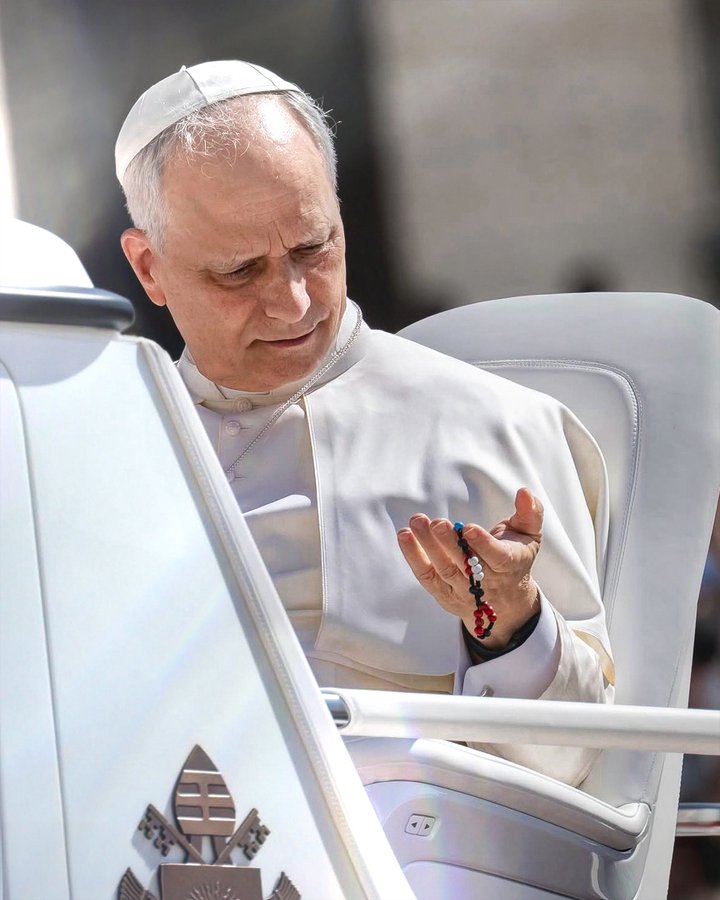
This is no nihilistic assessment of world affairs. It is a call, not to arms, but to peace. I was so moved by the words of Pope Leo (yes, Proddies, him again) earlier in the week in describing the role of tears in situations such as this one. Weeping is not a sign of weakness, but of strength; Christ cried out on the cross to his Father, and that type of anguished plea can be understood, the Pontiff said, ‘as an extreme form of prayer’.
Sometimes, love has no other outlet than to shed tears. I think we have now reached that point as a world. Cry, then, from the depth of your hearts, to the God of all comfort, because he understand us – better, even, I think – without words.
Christianity
Popes, Presbyterians and Piety
I have long been a connoisseur of quality bodaich and despite my upbringing and cultural leanings, it was somewhat inevitable that I should add the new Pope to my collection. It’s stretching the definition a little to include a sprightly fellow in his late sixties, particularly when it had been considered that his ‘youth’ might work against him in the conclave. Nonetheless, I’m counting him in.
Now, what is it, you may well ask, that appeals to a Leòdhasach of Calvinist leanings about the head of the Roman Catholic church? Please don’t write in, but here it is: his faith. I mean, yes, he’s photogenic and highly entertaining with his high-fiving, pizza-scoffing, baseball-signing ways. Nuns squeal with delight in his presence, and he has been gifted a truly sensational number of hats and cuddly toys, signalling a general acceptance that he is a cutie pie of the squishiest kind. And yes, I am well aware that this is not quite how the Westminster Confession of Faith refers to him.
But, here’s the crux. If we are Christians, ultimately we are only concerned with one thing: the increase of the Kingdom. Aren’t we? Doctrine has its place, of course, but when you see people who profess Christianity – Protestant or Catholic – wielding points of doctrine and even of liturgy and tradition as a means to gatekeep salvation . . . well, I am reminded of the good sense of God that he didn’t leave it in our hands.
I mean, I have thought for years what a shame it is on us that an island like Lewis hosts so many different (but not) denominations. You can’t get an onion-skin page of your Bible between any two of them in matters of doctrine and confession, but they have put supreme effort into locating even one difference that mandates them to sit in a separate, three-quarters empty building. Never mind that we do not have enough preachers, never mind that increasingly elderly congregations are burdened with heating and lighting churches across the island when we could probably all fit into one or two.
And if our hearts were fixed upon the love and joy of the Lord, that’s exactly what would happen. We’ve all read the revivalist accounts, where people couldn’t bear to be parted from one another, so continued praising God into the wee hours.
Now, we not only put up walls, but we form whole new denominations to show just how wrong those others are. Not us, obviously. We all think we’re worshipping the right way. It started off with eschewing the bells, smells and statues of the Catholic Church. And since then we have divided and subdivided so many times that we’ve now resorted to separating over what kinds of songs are sung in praise of God.
Chan ann san aon àite a tha an olc. This is not just a Calvinist thing. Since finding myself on the RC side of social media (this happens when you follow the Pope’s every move like a fangirl) I have read an awful lot of self-righteous nonsense from Catholics too – only the priest should hold his palms upwards when praying, the Eucharist should be placed directly on the tongue and not into the hands . . . Mo chreach, with all the petty bickering about the correct way to worship, I’m inclined to think that we have more in common than we might care to admit.
Which is my point here. There is one Redeemer, and he is the one route to Heaven. When he comes back to claim his church, I don’t think he’s going to sift us by denomination. Call me bold, but I don’t even think he’s going to ask us which songs we used to praise him, how we held our hands, and if we used beads, prayer cards, or candles. Faithful women who went hatless are probably not going to be counted less than hard-hearted ones who covered their heads.
Unless I have been on a very misleading path all this time, it is not about any of the
trappings. God gave us something that is, yes, undoubtedly, mysterious, and in many ways beyond our comprehension. But, more importantly, he gave us something so simple that a child can understand it; indeed, he said that WE must become like children to receive it. Not by squabbling over ritual, and certainly not by telling each other we’re damned because of the way we stand, or kneel, or wear our hair.

No, we must receive his free gift as he offers it. Complicating it is a sin because it may act as a stumbling block to someone else. What is wrong with us when we tell others that they cannot be saved because they have a statue of Mary, or because they allow musical instruments in their churches? Shouldn’t we be saying, ‘never mind HOW you worship, as long as your worship is of him, and for him’? Why aren’t we hungry and desperate to share our loaves and fishes with a multitude?
Yesterday, I watched Pope Leo preside over Mass with a group of people, described in the Vatican briefing as ‘the poor’. The Pontiff urged us to make no difference in our hearts, or in our dealings, between those who minister to people in need, and the needy themselves. Each, he said, meets Christ in the other.
Perhaps I am naïve. There’s a good chance this blog will be taken as further evidence that women are silly about doctrine and definitely shouldn’t have a voice in their churches. Nonetheless, in a world that is buffeted by the enemy, I think we should focus more on being Christlike – as the Pope has modelled throughout his life – saying little, but being and doing what we ought, witnessing effectively in faith. I prefer the white martyrdom of Leo XIV to the whited sepulchres that would damn us all on a technicality.
I’m not religious, but . . .
If the recent discussion of Tesco’s proposed Sunday opening in Lewis is anything to go by, people are pretty selfish. It’s basically been a rehash of Lanntairgate and that perennial favourite, Swimmingpoolgate. Even the arguments are versions of the usual thing: ‘we need to be like everywhere else’ and, in the case of the sports centre, ‘we need to be like Uist’. Smaoinich. It’s on us the two days have come when we can aspire no higher than that as Leòdhasaich.
Now, it’s already been established that the mighty supermarket is a business and, as such, couldn’t really give a stuff what we islanders think. Though they don’t exactly have a monopoly, they also know that we don’t exactly have a lot of choice when it comes to buying the messages. Therefore, Tesco can do what it likes.
Tesco can change the character of the Lewis Sunday without so much as a by-your-leave. Keep that in mind for a moment.
Now take a look at the pitched battle on social media between the pro and anti-opening lobbies. On the pro side, you will see one refrain repeated often: move with the times. Ah yes, the times. The times we live in, which we have every reason to be proud of – the times in which wars are fought over land, the times in which little children die, fleeing their despotic countries, the times in which politicians lie and defraud us. The same times – closer to home – in which old ladies are terrorised by kids who should be at home, in bed; in which respect seems to have died the same death as shame; and in which parents abdicate responsibility for the feral conduct of their offspring. Mmm hmm, those times sure are worth living up to.
The counter-argument and, as far as some of us are concerned, the clinching one, is that Christ said the very opposite. And, even if you’re not a believer, his teaching is worth paying heed to on this. He told his followers not to be conformed to the world. In other words, he exhorted them to keep to the path of truth and right. If he was here at this moment, I am pretty sure he would be reminding us of something important: the Sabbath was made for man, not the other way round.
What does that mean? Well, it means that the day of rest was created for the benefit of all humanity – not just professing Christians. So, think on that, if you’re one of the ‘you do you’ brigade. And perhaps also consider this from a different perspective to your opinion on whether or not YOU want the supermarket to open on Sundays. Think of the staff whose families will have to make the sacrifice so that you and I have the option of maybe, occasionally, if the need arises, perhaps, nipping to Tesco once in a blue moon if we want.
Is it really worth it? Are we so utterly sure of our own judgement that we are happy to end a particular way of life simply because a corporate giant wishes it. In fact, if their local manager’s statement is anything to go by, this is being proposed because Tesco is too tight to build a bigger store with more parking. The idea, the demand, has not come from the customers. Yet, we are content to allow a company which offers a cut-rate service to alter the very character of our community.
That’s what this comes down to. And the ‘what about visitors’ defence is an extension of the ludicrous way our islands are being run. Where else would you have business interests trampling so blatantly over the local culture with no one to defend it amongst our local leadership? It’s staggering to me that some islanders and island residents are content to let this just be imposed by commercial concerns.
But, then, I’m often fairly shocked by what islanders are willing to permit.
Like many commentators on social media, I’m not religious either. Religion is often the enemy of Christianity and of common sense. It is not religiosity that makes me wish to see the Lewis Sabbath unaltered, but my personal experience that its rest is a godsend. For me, that is a literal thing. However, whether you believe it was ordained by the Lord, or not, the benefit derived from a universal day free from the obligations of commerce is undeniable.
People, community, culture are more important than trade or mere convenience. But once those precious things are altered, they cannot be put back the way they were.

A Birthday Tribute
Today, had things gone to plan, I would be celebrating my husband’s sixtieth birthday with him. When I say ‘plan’, I mean ours, not the eternal one. And it has, at times, been a bitter pill to swallow that this isn’t a mistake, or an aberration of some kind – this is precisely what was meant to be. Donnie was meant to die five months short of his fifty-second birthday, and I was meant to be a widow at thirty nine.
I accepted this because, well, I accept the sovereignty of God. And, most of the time, I accepted his wisdom and his goodness. Yet, I am human and sometimes it was hard not to dwell on what I had lost, and on what Donnie would miss out on by dying so young. One of the hardest things was a school photo of his that surfaced on social media, shortly after he died – seeing him as a cute, wee boy with all his life ahead of him . . . it was almost unbearably poignant.
I used to comfort myself with the idea that the grief would get easier, which it does, mostly. What I didn’t know was that it would still wash over me in waves that sometimes feel, even now, like they might utterly engulf. It made a friend laugh recently when I told her that, after he died, I used to wish it was five years in the future so that things would be easier, better . . .
That would be 2020, then, year of Covid. I think Donnie himself would laugh at my unfortunate wishful timing.
On what would have been his sixtieth birthday, therefore, I simply want to pay tribute to a quietly wonderful man. He would never have allowed it had he been here, but there’s no one to stop me singing his praises now.
He proposed to me while wearing a Santa suit – fittingly, as being his wife was without doubt the greatest gift he could have given me. The proposal was cemented initially with a locket he’d bought me because he’d lost his nerve in Ernest Jones after going in to buy a ring. ‘I don’t know what an engagement ring looks like’, he said, as though the whole thing would have been a thorough mystery to the jeweller as well.
Usually he didn’t balk at buying me presents other men might consider embarrassing. I think the ring was different because it symbolised something so important. Donnie understood what mattered, and to him, at thirty nine, this was a big step. The day we went to the manse to discuss the service he was nearly delirious with nerves. Somehow, I think he had it in his head that the minister would catechise him or something. These nerves carried on right up to the big day itself, when only a stern ‘don’t you dare’ from his big sister stopped him from being sick!
It’s funny to think back on how he reacted to these small pressures because, when the ultimate test of his mettle came, we all saw the man he was, and none more than me. He faced his initial diagnosis matter-of-factly, endured treatment with stoicism, and looked upon the end of his life with total reconciliation. If he shed a tear he never did so in my presence, and all his worries were for me – would I be financially secure, would I be taken care of. When I told him that I would be alright, that I would not give way to despair, he seemed surprised at the very idea that I might.
His faith, you see, was far ahead of mine. He was only concerned with practical things, things that he could do for me – things he felt he SHOULD do for me, even at the end. The rest, well, he knew he was leaving that in safe hands.
How often I have imagined his wry comments and mischievous smile over the last eight years. He would have had much to say about world events and local politics. A mild-mannered fellow most of the time, he would have erupted into protective fury at some of the situations I have found myself in – but, then, most of these wouldn’t have happened in the first place had he been here. From almost the first moment we were together he made me feel safe, cared for, and like the most precious object in the world. I was first in everything, the apple of his eye.
Of the few regrets I harbour, one is the fact that many special people who have come into my life since then never knew him. He would have loved them as I do, I’m sure. In moments of weakness, I regret that he will never again insist on running me a bath, or pouring me a glass of wine because I’ve had a hard day. Donnie was the sort of man who filled my life with small kindnesses – flowers from the supermarket, my favourite chocolate, compliments and, though I can scarcely remember why, frequent expressions of gratitude.
Known in his own family as ‘Dòmhnall Beag’, and sometimes just ‘Beag’, I never knew a man of greater moral stature. He genuinely never put anyone ahead of himself, and his first instinct in every time of trouble was to ask what he could do. His bravery, for a man of any size, was titanic.
After he died, I read the diary he’d been keeping in his last months. It was entirely filled with reflections of gratitude and love, just as his life had been. He broke me with this entry, however: ‘I hope Catriona meets someone who will be good to her. She deserved so much more than this’.
The thing is, a Dhòmhnaill, you set the bar impossibly high; I don’t believe there could be more than we had. And though there are days I wish God’s plan had aligned a little more closely with ours, I can hardly be surprised at his haste to bring you home.
Whenever I’m cast down by the way his plan unfolded, or am tempted to question providence, I look at all he has given me, and it is well, it is well with my soul.
How can I hand you over?
Christina Rossetti’s poem, ‘Remember’ has a particular resonance for me. It asks that she be remembered after her death, when ‘you can no more hold me by the hand, nor I half turn to go, yet turning, stay’. These lines came back to me when my husband was dying, because they reminded me of a particular weekend when he had to leave home on Sunday instead of Monday, in order to attend some work training. We had been having such a lovely weekend, and both of us were sad that it needed to end that much sooner. I was trying to put a brave face on it, when he suddenly took off his jacket, chucked his bag back into the wardrobe and decided not to go after all till the following morning.
I remembered this so many times as I sat by his bedside in the hospice. And I remembered Rossetti’s sentiment – that death revokes the option to remain. How I wished he could hug me as he had that Sunday, and tell me he was staying.
It came back powerfully to me again this morning in church.
God restrained his own hand many times against the Israelites, never permitting them quite to suffer the fate they deserved. In the prophecy of Hosea, he asked himself, ‘How can I hand you over, Israel’? Yet, in the preceding verses, we see countless reasons for him to do just that, given the unfaithfulness of those who called him ‘God Most High’. Even though their words were not matched by their deeds, still God resisted giving them over to destruction. Such was his love for his own people that he was not willing that any should perish, and he has repeatedly held us away from death since.
But not his own Son. Jesus was not spared any of our punishment. The guilt was ours, yet the suffering was all on him.
This is love. It is incomprehensible to our small minds but my word, it should leave a colossal mark on our hearts. God couldn’t bear to punish his sinful, disloyal people for their own dark deeds; but he willingly gave up his Son to that death on the cross, to the stark moment when he cried out, ‘My God, my God, why have you forsaken me’?
We cannot know the mind of God, but it’s incredible to imagine the Father doing to Jesus what he would not do to us. And it is equally astonishing to think of Jesus, walking to Calvary and to death . . . and not turning back from it as any one of us would, given the chance.
Today’s sermon ended with the minister reading some testimony from a Pakistani Christian who – like many of his countrymen – has been disowned by family for converting away from their faith. Yet, he said, the empty home and the silent telephone are not reasons to pity him, because he knows that God has something far better for him, and there is no loneliness in Christ.
I can put my ‘amen’ to that, except in one respect. The awe I feel at this man’s sacrifice, is because it reflects God. Neither God the Father, nor the Son, spared himself in redeeming us. Painful, soul-searing sacrifice was willingly made. Ditto this Christian whose profession made such a moving end to today’s sermon.
Any losses I have sustained were not sacrifices willingly given. I don’t think I would have had the strength, or the faith. But, there again, God’s infinite love didn’t ask me to give what I could not: in the light of Christian understanding, therefore, even his taking away is kindness itself.
That’s the heart of God.
Long-suffering in the Free Church (it’s not about the pews)
Going to church can have unintended consequences – unintended by yourself, that is, of course. I went this morning, thinking that after a week on antibiotics for the mother of all dental abscesses, I knew the meaning of long-suffering. Indeed, perhaps I could even be perceived as the living embodiment of it myself. Three sleepless nights, endless pain which didn’t respond to any amount of ibuprofen, salty mouthwashes or stern talkings-to, and yet I had retained my sanity and even some humour. Perhaps, I allowed myself to think, I am a paragon of putting up with adversity.
You know, though, when you’re leaning towards seòladh àrd of any description, there’s always a Calvinist minister, just waiting to take you down. ‘Think you know what it is to be long-suffering’, they mutter as they stab their sermon notes out on ancient typewriters (in my imagination), ‘just wait till you hear what I have to say’.
Now, let me be clear on something. The take-down for myself this morning was in the substance and message of the sermon, not the delivery. I am in no way suggesting that a Free Kirk service is an object lesson in fad-fhulangas, however hard the pews.
This is all the more remarkable because it wasn’t a sermon on long-suffering, but on unity. It was Ephesians 4, and Paul’s call for unity in the church of Christ. Lack of unity grieves the Spirit, and it grieves him because he is a person of the godhead. In a quite beautiful image, the gift of unity was compared to the gift of Eden: just as the garden was given to Adam to tend, unity in the Spirit was gifted to the church for us – all of us – to nurture. I am tempted into a segue here, but some things don’t need to be repeated, far less hammered home. We are all capable of meditating upon our own role in caring for what we have been given, and growing it to God’s glory.
I can and have picked holes in how we are as a church. Not gratuitously, I hope, but out of a real, prayerful concern that we are not as we should be. In reality, no Christian needs me to point that out – and there has to be some measure of gratitude for the fact that, to paraphrase Newton, we are at least not as we were. Crucially, though, we are not as we will be: we are the Spirit’s work in progress. And, listening to that sermon today, the unintended consequence for me was that I was both reassured and comforted, yet chastened and humbled also.
Christ did all that he did. He lived a life of service, putting everyone else first. A deserving everyone else? An impeccably behaved everyone else? Far from it. He poured himself out for a world that despised him. Even his own followers were not always faithful, taken up with a wrong vision of the Kingdom. James and John even jockeyed for a status of power within a government that was never intended to be built on any such thing. It must have been so disheartening for Jesus, not to have one wise friend, one close confidante to whom he could go for counsel. There was not one he could trust implicitly to do the right thing.
This was why the answer to ‘whom shall we send’ and ‘who will go for us’ inevitably came back round to Jesus, for there was indeed no man.
Add to all this that he had no place to call home, no door he could close and be alone with his Father when disappointment and disillusion assailed his heart. Yet this same Jesus went willingly to the cross for those inconstant disciples, for a world that bayed to see him crucified and chose a criminal to be his substitute for mercy. Still, he elected himself our substitute for punishment, in the full knowledge that we deserved no reprieve.
And we fall out over the merest thing. Ironically, while waiting for the service to begin today, I overheard a whispered conversation regarding another congregation who are ‘together, but with undercurrents’. We are not long-suffering in the least. I forgive and excuse my own bad behaviour most readily, but I’m not so merciful to others. The slights and insults, the wrongdoings of my brethren are placed under my magnifying glass, while my own shortcomings, well, they’re easily excused.
What an absolute plate I have. Unity is a gift of the Spirit to which all of us who profess union in him must tend. The only way to that, the only way to anything worth the having, is through Christ. I am going back to one of the books I read assiduously as an apprentice secret disciple, ‘The Imitation of Christ’. Surely I should remember these words of Thomas a Kempis:
‘Be not angry that you cannot make others as you wish them to be, since you cannot make yourself as you wish to be’.
Christ can, though, for all of us – and he will finish the good work once it is begun.
A House Divided
There is an amusing scene in the Scottish film, ‘The Bridal Path’, when the naive protagonist goes to withdraw some money from his bank account, and is asked ‘what denomination’? He replies – of course – ‘Church of Scotland’.
In my own part of Scotland, denomination has been all too important, time out of mind. I wonder how many of us feel that we belong to the Church of Scotland, or the Free Church, or the Free Presbyterian Church before we belong to the church of Christ. And I equally wonder how Christ, the head of the one church there is, feels about denomination.
How have we come, in a town like Stornoway, for example, to have two Free Church congregations, three Churches of Scotland, a Free Presbyterian Church, a Free Church (Continuing), an Associated Presbyterian Church, a Reformed Presbyterian Church, and sundry other congregations? It would be nice if the answer to that was that no one building could contain all the worshippers. That, after all, is the only acceptable justification to have the saints of God distributed across a multitude of churches.
I know this is an awkward topic, and some people don’t approve of it being aired – but we are bound to review our own conduct in light of God’s presence. And like the adulterous woman at the well, we don’t need to hear any accusing words from Him to be convicted of this sin.
Because that’s what this is. It’s pride. Resentfulness. Self-righteousness. It’s putting ourselves and our traditions first.
Now, I’m as guilty of this as the next person. I like the plain worship style of the island Free Churches, with no accompaniment to our Psalms-only liturgy. Heck, I even like the pews. But, if the necessity and blessing of online church has taught us anything (as I believe it was meant to), it’s that the building isn’t the church. And if the building isn’t the church, the denomination with all its committees and rules and manmade fol-de-rols sure as fate is not the church either.
Yet, we cling to these divisions as though they might be important or worthy. With no outward embarrassment, with no attempt at unity of even the most superficial kind, we have our own separate rule books, our own General Assemblies, our own identities.
As if the identity conferred by belonging to God is somehow less than that of some combination of the words ‘church’, ‘Presbyterian’, ‘Reformed’ and ‘Free’. We declare ourselves freed in Christ – free indeed – and yet, still, we entrench ourselves, not for Him, but invariably for some ‘principle’ that has us standing on our dignity. And while we bicker amongst ourselves (the children of God, mind you) about how to worship, He not only goes unworshipped, but the banner of His beautiful cause sags into the mud. The unsaved watch, open-mouthed, as those of us who profess Christ act like we have never even heard His name.
You think I exaggerate, perhaps – that I’m being harsh and judgemental?
There are four seats on Comhairle nan Eilean Sitar’s Education Committee, which are allocated to faith representatives. One, by statute, is occupied by the Church of Scotland and two, by custom, by the Roman Catholic and Free Churches as being together representative of the islands’ faith profile. The fourth has in the past been filled by the Free Presbyterian Church, but the Chief Executive of the council this week told members that he’d had representations from another denomination, suggesting that they should provide the fourth representative instead because – and I quote – they have a larger membership.
Let that sink in: Christians – Reformed Evangelicals between whose confessional positions you could not slide one page of the KJV – trying to best one another for a seat on the Education Committee.
Thanks to their unlovely one-upmanship, it looks like that seat will be shared with other faith groups, including some that are non-Christian.
That, folks, is an object lesson in what denominations do for the cause. The sad truth is that we show no intention of dwelling together in unity, and actually pour more energy into preserving superficial difference than pursuing the one thing needful: togetherness in the Church of Christ.
What a witness we are for the Saviour; what an example to the unsaved. My advice to the council would be not to let any of us near an Education Committee until we grow up.
Keep A Thing Seven Years
There’s a Gaelic saying which suggests that if you keep a thing for seven years, a use will be found for it. Sometimes, though, it doesn’t take that long.
This Sunday, I will have kept my grief for seven years. Like many new possessions, I carried it with me everywhere for the first while, moving it around as self-consciously as a child walking in stiff, leather shoes. When it was worn in a little, I started to forget for minutes at a time, only to be assailed by the reality of it when I least expected. In the last few days of Donnie’s life, I had been painfully aware that some time very soon I would no longer be a wife, but a widow.
I didn’t like the word and still less the idea that it represented.
Yet, in seven years, I have been taught to wear the mantle with something approaching acceptance. Instead of being allowed to push the garment from me, God has gently shown me that it IS mine to put on, every day. Traditionally, it also took seven years to train a piper, before they would be allowed to perform in front of an audience. There was no such apprenticeship for me, though – just straight in at the deep end.
I often think how this might all have been, had but one thing been different.
These seven years would have seen me grow bitter, perhaps, or reckless. I might have spent my time in wishing my husband back, or wishing I’d never met him – anything, in short, to remove the excruciating pain. The memory of his suffering could have tormented me to who knows what depths of anguish.
The one thing, though, which saved me from all of that was the hand on my shoulder. It wasn’t simply Christ saying, ‘I’m here, you can lean on me’. That would have been wonderful enough. In fact, his message was subtly different. He was actually telling me, ‘Remember I’m here. You know what to do’. This wasn’t the beginning of a wonderful new relationship, but a life-changing development of one that I hadn’t truly known I was in.
While I have carried – and will carry – Donnie in my heart, it is not loss which dominates my reflections over these seven years without him. It is gratitude. I had such a marriage that I didn’t think I could live without him. But God used that blessing to show me a much deeper and more enduring love. He has fulfilled me in the years of my widowhood, and shown me that, in Christ, all situations are an opportunity to know blessing.
I have profited from his teaching. It goes without saying that I have benefitted in more ways than I can count from his love and mercy. From the very beginning of this journey, though, God has laid it on my heart to share my providence with you. He did that, and then he made it possible.
Most miraculous of all, he took what might have destroyed me and blessed it to the extent that I can say that the Lord gives more than he takes away. Last Sunday, our minister used the sermon time to remind us of the glory and holiness of this God. And, right at the end, that devastatingly beautiful flourish of truth: ‘Remember, though, he is also your Father’.
Glorious, holy, perfect – of course; but tender and loving to the last. Not ‘also in our hard providences’ but especially. If you don’t believe it, I will take you to see a man who told me all things I ever did, and loved me just the same.
‘Daddy, paste it’.
In what would undoubtedly be considered revealing by any psychologist – especially the cod variety – I had an unfortunate childhood habit of removing my dolls’ heads. My father would then be called upon to reattach the noggin, which he did over and over again, without much complaint. I had an unshakeable belief that he could fix anything, therefore – an attitude also displayed in the film, ‘It’s A Wonderful Life’, when Zuzu’s flower sheds a petal and she demands, ‘Daddy, paste it’.
This morning, I echoed Zuzu’s request. Our world – handed to us in perfect working order by our heavenly Father – has been broken and broken again. Today, the people of Ukraine are suffering the consequences of that, as their country is torn apart around them, and many are forced to flee for refuge elsewhere. As Putin’s relentless display of ‘strength’ continues, the collateral damage is immense. Homes are destroyed, families separated, loved ones killed in the midst of terrifying chaos. Other world leaders wring their hands hopelessly and look at each other, wondering how – short of military action – they can stop the despot in his merciless tracks.
Political leaders fear the might of Russia, and despair at the idea of China rallying to Putin’s side. These presidents and prime ministers do not know where to turn because what they see with their eyes is bigger than all their forces put together. The media invokes the imagery of World War II, when Europe and America last found themselves in a pickle to equal this.
But there is a vast difference between then and now. Then, you had leadership that, instead of wringing its hands in despair, might have clasped them in petition to the Lord; then, you had some people of faith, who knew that the mightiest army of all was fighting at their shoulder.
The helplessness we are witnessing in our leaders is the consequence of believing that you are the ultimate power, and that there is nothing beyond yourself to which you might look for guidance, for wisdom, or for strength. When you are strong, Biden, when you are strong, Johnson, then are you weak.
Yes, the church elders are praying, and calling upon their people to do likewise. But it isn’t at the moment of crisis, this witness is needed most. As a Christian community, we are doing what the Ukrainian leader is doing in his desperation: chucking weapons into the hands of civilians who have no idea how to deploy them. We ought to be testifying unceasingly to our political masters, interceding on their behalf with God and begging that they would see their own need of him – in all situations. Glancing through the March issue of the Free Church ‘Record’, I saw something incredibly wise in the prayer diary. It was a request to pray for people whose lives are so great that they see no need of God. No one is wishing them pain or suffering; but we do wish them the sincere yearning for the Lord that seems so absent in easy situations. I think we need to be in prayer, likewise, for our political leaders, that they would lean on God’s wisdom and strength in times of peace, so that it’s familiar and instinctive to do so when trouble comes.
Even now, though, as the tyrant batters down the gates of what we were pleased to call ‘peace’, it is not too late. Those of us who pray must put our shoulders to the wheel, and ask God to turn our helpless leaders into praying people also. I don’t know how many more messages we can expect him to send, signalling his displeasure, before we turn to him again in earnest. And those among us who do not pray, are you reading this? We have seen that people being the ultimate power does not work – it wrecks lives and it destroys this beautiful world. Ego always tries to triumph over humanity, imposing its will in a show of destructive strength, not caring who it tramples along the way.
The capriciousness you attribute to God is not his, but ours. Putin is a product of the way in which we have chosen to steward creation, with hardly a passing thought for the Author of all things. No wonder that men become drunk with power and blinded by self-importance when they think that they have actually taken God’s place.
Luckily for us, humanity is not the ultimate authority. When we look around us at the harm believing the contrary has done, however, surely we can admit that there is only one course of action left to us. We have got to humble ourselves, hold up this broken world to heaven and beg:
‘Daddy, paste it’.
The Compassion of the Christ
Today was a communion like no other. The old traditions had all been peeled away, and only the essentials remained: the bread, the wine, the table, and a gathering of God’s believing people.
It was enough.
And the words that called to mind the loneliness of Christ’s suffering could not have been more apt for such a time as this. Many of us have gone through a protracted period of aloneness over the last two years. Families and friends have been separated, people have met death without loved ones to hold their hands. I cannot imagine what it must be like to have been bereaved during the pandemic, especially in communities which normally show their support by drawing alongside those who mourn. Who could forget those images of our newly-widowed monarch, sitting quite alone in St George’s Chapel? In that moment, she symbolised the loneliness of many across the nation.
Yet, she cannot feel your grief or mine, anymore than we can experience hers. For that, there is none but Christ.
Not only is he acquainted with grief, he has borne the unimaginable loneliness of being cut off from God. He chose to take that into his own experience in order that he might obliterate it from ours. Listening to the minister today, speaking of the peculiar loneliness of the Saviour on the cross, I was reminded of Derick Thomson’s poem, in which he speaks of peeling back the Lewis sky to behold:
‘the Creator sitting in full view of His people
eating potatoes and herring,
with no man to whom He can say grace’.
No man to whom he can say grace. No man to have compassion upon him in his pain. No man he can send.
Even in my more cynical or despairing moments, when I think there is no one to whom I can turn for advice, no one I can trust . . . there is. In these two years, during which I have been much alone, I have not been lonely. There are friends, there is family – but better than any of those, there is Christ. His advice never fails, his presence never departs; he has plumbed the depths of his own loneliness and so he is the soul of compassion in ours.
We are a society in sad need of compassion. I see a strange set of parallel phenomena creeping in. The more we say, ‘be kind’, the less able we seem to be able to apply that – as Christ does – to everyone. There is a drive to stand with victims of all kinds, which is as it should be. More understanding and not less can only be a positive development. But, are we unable, or simply unwilling, to offer a second chance to people who have gone wrong? Our world sends some into the wilderness forever, guilty of unforgivable falls from grace in our eyes.
That’s not how Christ deals with anyone. It’s not how he dealt with me; it’s not the example he set his followers.
He hung on a cross and endured the ultimate loneliness, to an extent we cannot begin to understand, in order to save us. To take that legacy of love to ourselves, we have to imitate him – he has always known the very worst and darkest details of our hearts, yet never abandoned us. Accepting his gift means sharing it abroad.
Sharing it abroad, means peeling back to the essentials as symbolised in those elements today. The death of Christ accomplished our salvation, but not so that we would keep it to ourselves.