Did We Lose Our Sins in Translation?

Working in a Gaelic environment, I frequently hear obscure words being used. At least once a year, for example, a student will attempt to revive ‘fa-dheòidh’. I quite like it, but it creates much the same linguistic effect as if I were to pepper this blog with ‘forsooth’.

Recently, the minister, in throwing me a clan-based insult (yes, it still goes on, even all these years after Culloden), introduced me to the word, ‘eanraich’, which is apparently some kind of soup. It was – presumably – in regular use at one time along with ‘fa-dheòidh’ and other linguistic curiosities. When the social and cultural context for vocabulary goes, however, the words themselves swiftly disappear too. People no longer use horses for agricultural work, and so all the Gaelic terminology for a horse’s tack is redundant; likewise crofting, fishing and many other traditional practices besides.

Although you rarely hear it included in that category, churchgoing falls into the realm of traditional Gaelic culture. It had – and has – practices of its own, influences of its own and certainly vocabulary of its own. I know many Gaelic speakers who say that they can’t ‘follow’ a sermon in their own tongue because ‘the language is too obscure’. There certainly IS an ecclesiastical Gaelic, which employs words not in everyday use: ìobairt, ceusadh, aiseirigh, peacadh. I must confess a certain weakness, as it were, for ‘teachdan-geàrr’ And that is a play on words for my bilingual readers which would lose much in translation.

‘Sin’ loses quite a lot in translation too. The word, ‘peacadh’ in Gaelic is used virtually exclusively for the theological concept recognised by every dutiful Wee Free as ‘a want of conformity unto, or transgression of, the law of God’. In English, however, ‘sin’ came to be used in two ways – in ecclesiastical circles of course; but also in a superficial manner. It is not uncommon, for example, to hear non-Christians say, ‘it’s a sin to throw all that food away’, or ‘it’s a sin that Mrs MacLeod’s daughter doesn’t visit her’. The things being described as ‘sin’ frequently are, but the people who label them as . such don’t really mean it in the catechism, ‘want of conformity unto the law of God’ sense. They might just as soon have said, ‘it’s a pity’, or ‘it’s a disgrace’.

Recently, sin has been in the news. Oh, it’s there all the time, of course, but like its master, usually goes under a variety of pseudonyms. On this occasion, however, someone asked a politician whether he thought that homosexuality is a sin. When the journalist sensed prevarication, the politician was harangued and badgered. This happened repeatedly. If you are unfamiliar with the ways of the British media, let me tell you that politicians are not usually asked about sin – it is not one of the top ten issues in any election campaign.

So, Christians should be delighted that, at last, sin has made its way onto the political agenda, right? Wrong. It hasn’t. Tim Farron was only asked about sin because he’s a Christian, in the same way that a multi-millionaire might be asked about tax loopholes. The mainstream media sees Christianity as a weakness, something to humiliate believers with. After all, Farron was not asked about sin as such – he was asked whether he thought that something was one.

Christians are not actually required to have an opinion on sin, other than that held by a famously fiery preacher in the USA in the early 20th century. Calvin Coolidge, the notoriously monosyllabic president had been to hear the man preach. Attempting to draw Coolidge out, a friend asked what the subject of the sermon had been. ‘Sin’, replied Coolidge. Exasperated and wishing for more detail, the friend asked, ‘and what did he say about sin?’ To which Coolidge responded, ‘he said he was against it’.

Sin isn’t a matter of opinion. God has decreed what is an affront to Him, and Christians try to conform in obedience. If you want to know whether something is a sin, should your first port of call really be a sinner, albeit one saved by grace? Why ask fallible Farron, when the word of God is readily available to answer all such questions unambiguously?

Our tolerant, liberal, progressive society does not want the truth about sin. It could not handle the truth about sin. If the doubters opened their Bibles to Romans 3, they would read that ‘all have sinned and fall short of the glory of God’. Set within the wider scriptural context, this tells them everything they need to know about what sin is and, more importantly, what sin does.

It is uncompromising. We can’t debate, barter, bargain or otherwise spin our way out of sin. Something which is sinful cannot be made acceptable in God’s sight just because the world has winked at it. Tolerance, liberalism, progress – these three recognise no sin except one: calling something ‘a sin’. Christians have to be ridiculed, derided, silenced – they are the enemies of a progressive society. Yes, that’s what we have: progress. Who needs the Bible with its backward notions of sin? Humanity knows best, humanity will rule by its own lights. What could possibly go wrong?

Remember, humanity progressed itself right out of Eden.

Your Father’s Side & The Family Name

It is hard to believe that we Hebrideans have any Viking DNA. I imagine that if a young Lewisman had ever said to his parents that he was off on a summer adventure to sack and loot, to raid and pillage, their reaction would almost certainly have been, ‘ach dè bhios daoine ag ràdh?’ What will people say? Surely marauding on this scale would reflect badly on them and therefore would have to be nipped in the bud.

‘What will people say?’ used to be the refrain of parents and grandparents in the island. Nowadays, people think of this attitude as narrow-minded, judgemental and stifling, but I think it helps to reflect a little on how it developed in the first place.

Your village was your world. The neighbours were as familiar to you as those who occupied the same home and shared the same surname as you. Besides, you didn’t go by your surname – you went by a patronymic, a chain of names stretching back into the distant past, connecting you to people you had never known. Perhaps you had some of their characteristics without knowing it. If you did, some cailleach in the neighbourhood would notice. ‘Iain Dhòmhnaill Sheumais used to walk like that’, or if she was feeling acerbic, ‘It’s a shame you took after your father’s side. Your mother’s people were good-looking.’

People knew one another inside-out, which meant knowing their history. Not just their personal history, either, but being able to place them in the context of their lineage. Forget Burke’s Peerage, your average cailleach had an encyclopaedic knowledge of her own people and those of her neighbours. It meant that they could see where your good points and your bad had emanated from. And so, your personal conduct would be added to that. The responsibility not to tarnish a good family name rested equally with each member, and each successive generation. Any deviant behaviour was likely to be dismissed as ‘rud a bh’ anns na daoine’ – a weakness in your people.

Now, of course, we don’t have villages; we have ‘communities’. Some are more community-minded than others and it’s not always the ones you think. I live in a rural village where there is quite a lot of Gaelic spoken and some crofting still taking place. You will even see the odd peat-stack. Nonetheless, when I was widowed, my immediate next-door neighbours visited, but no one else.

Had I lived fifty years ago, I would have been Banntrach Dhòmhnaill Chaluim and the neighbours might have rallied round; nowadays, I don’t have that comfort, or that status. I am not on their radar. People probably don’t even talk about me, no matter what outrageous – hypothetical – thing I do. It doesn’t matter to them because I am a stranger. Community in that sense has gone and many of us now seek that feeling of belonging and identity elsewhere.

For me, it has come from my church. I have been blessed with a close and supportive family, and my church family has been likewise.

My church family has at least as many quirks as my actual relatives. There are those who make you laugh, who laugh at you, who are always ready to help, who always want you to help, those who encourage and those who gently put you in your place. It has its father figures and mother hens, its bossy big sisters and cheeky wee brothers. This family has get-togethers and minor disagreements, outings and heart to hearts.

And this family knows its own heritage. When we are together, no one has to ask, ‘who do you belong to?’ We have the same father. He knows us all more completely than we know ourselves; and yet He loves us nonetheless. Each of us carries the unfortunate burden passed down from our first parents, and each of us has added some particular sins of our own. It is in our DNA to rebel.

Keeping together, though, returning often to our Father’s house, I think, is the only way we can refrain from bringing shame on the family. Reputation is very important when you are responsible for more than just your own. In God’s family, we need to reflect on our conduct more frequently, and ask the question again: ‘what will people say’? We have to fight against ‘rud a bh’ anns na daoine’.

Surely this is one setting where the ultimate goal is for everyone to see that we take after our Father, and that the family have care of each other. I hope that’s what people will say.

The Emperor of Maladies and the Everlasting Arms

When someone you love is diagnosed with cancer, your world changes forever. Suddenly, you see everything through the prism of anxiety. You are afraid to make plans, afraid to laugh, afraid to presume. Life is no longer about living; it becomes about surviving. Normal service is suspended. A shadow lies heavy over everything and threat hangs in the air. Your life, that fragile, bird’s egg of a thing that you have constructed so carefully, may be crushed at any moment.

I lost my granny to cancer many years ago, when I was nine. Then, when I was eighteen, news came that my friend’s mother, a wonderful, funny, vital woman, pillar of my childhood, was dying. It was the first time in my life I ever experienced the kind of shock that makes the breath leave your body. And when I was 38, my husband was diagnosed.

All that time passed between my granny’s diagnosis and Donnie’s, and yet the word had lost none of its power to frighten. It feels like the same strong enemy it has always been. There are not too many conditions that’s true of. Small wonder that Siddhartha Mukherjee called it ‘the emperor of all maladies’. A sadistic emperor, I would venture, one that loves to create pain and grief.

What is the purpose of all this suffering? We are no more entitled to know the answer to that question than we are to know the other great mysteries of the universe. Faith is content with the fact that there is a purpose.

I have come to the conclusion that, just as sin is sin, trial is trial: there is no gradation in God’s eyes. If you have Him, you can go through it, whatever it is. Cancer scares us, but He works everything for good; whether that’s healing and recovery, or bringing you home to be with Him.

The biggest question is not, actually, why does He permit this suffering, but rather, how does He want us to go through it? We have already got part of the answer. He wants us to go through it with our eye fixed on Him. And I believe He wants us to be overwhelmed with fear, or pain. Not because He is a sadist or any of the other blasphemy that people like Stephen Fry accuse Him of, but because He wants us to stop trying to do everything on our own. It is possible that, as CS Lewis put it, pain is God’s megaphone to rouse a deaf world.

Not long ago, our prayer meeting heard of Joshua and the parting of the Jordan. The Ark of the Covenant led the Israelites through the river and onwards to the Promised Land. In our own wildernesses, we need to do the same: fix our eyes on the Lord that leads us through every Jordan.

It’s easy to let sheer sick terror paralyse you when you’re worrying about a loved one. But you need to take that worry to the throne of grace. In my own most despairing moments, I did and this was the answer I got:

For we know that if the tent that is our earthly home is destroyed, we have a building from God, a house not made with hands, eternal in the heavens.
2 Corinthians 5:1

In the awful minutes after hearing that Donnie would die, the nurse who broke the news said, ‘if I could take this from you, I would’. It’s exactly how I feel every time I hear of another cancer diagnosis: the word itself is an assault on my heart. Anyone who has gone through it would not on any account see another suffer that fear and that pain which the word, ‘cancer’ always brings.  Yet, I know that God blesses us in these trials too, if we will only hold fast to Him.

Don’t listen to the people who tell you that you will get a back according to the burden; you won’t. He carries the burden with you and sometimes for you. God WILL give you more than you can bear, because He wants you to hand it straight back to Him. Your strength will not be up to this, but His is more than sufficient.

Shared adversity brings people together. How much more, then,  does it create closeness with God when you allow Him to carry you. I know that cancer brought my late husband into much closer communion with his Lord, and gave Him assurance of salvation. It did as much for me too. Cancer was, for us, the ugly messenger which brought good news. We no longer have one another, but we each have something infinitely better and lasting.

Cancer is not a person. It is not an enemy with plans, or feelings. We give it too much power. When it comes into our lives, like every other test and adversity – or, for that matter, every blessing and joy – we need to commit it into God’s safekeeping. He knows what to do with it because He knows its purpose.

In all of this, we have to look beyond the malady, beyond the sometimes gruelling treatment process, and see the Ark going ahead of us and parting the way. He is in the midst of these troubled waters too.

Cracking Pots & Wee Free Code

Those who are out both ends, and follow this up by coming out on a Wednesday night, are often expected to go forward. In the Free Church in Lewis at least, this has been the time-honoured course of things. It is code for regular attendance at Sunday services, leading to appearances at weekly prayer meetings, culminating in a profession of faith.

The fact that we have our own terminology surely suggests that it’s of some cultural significance. A social anthropologist would call it ‘ritual’, which word on its own used to be enough to make any respectable Wee Free faint. ‘Ritual’ evokes images of candles and altars, and . . . I’ll stop there out of respect for any of my denomination who might be reading this in possession of a pacemaker.

It is, however, a cultural norm. Not one set in tablets of stone, though. Contemplating going forward, I used to think of all the things I’d be more comfortable doing. Having a chemical peel, bathing the cat, parachuting out of a plane . . . and I settled it with myself that I wouldn’t – couldn’t – do it. You see, I had an image of what it was going to be like. Let me paint you a picture . . .

I knock on the door of the session room. The hubbub of voices from within ceases immediately. There is a long pause. Heavy, Calvinist footsteps. With a creak, the door opens a fraction.
‘Yes?’ the elder says. He doesn’t smile. Their smiles have been left on the pegs outside, along with the black coats and hats.
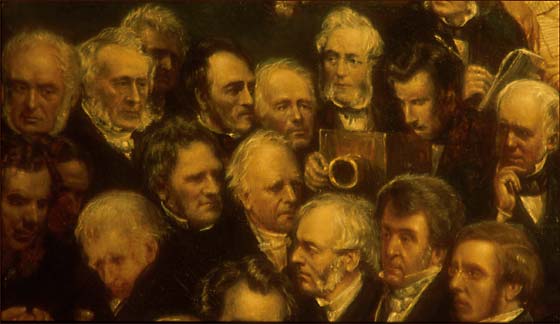
In a tiny voice, I mumble my desire to profess faith. A moment of silence, then a long, drawn-out sigh. The door is opened wider. Behind him, I see a scene exactly like David Octavius Hill’s famous Disruption painting. My eye falls on the minister, who is looking at me in disbelief.
‘You? Really? I mean, really – you?’ he asks incredulously, as the whispers of, ‘who is she?’ rise to a crescendo behind him . . .

IMG_0475

My horrified imagination would go no further and I nursed the label, ‘secret disciple’ to myself. Our cultural norms give you plenty opportunity to justify secrecy. There was, historically, a strange sort of almost-pride in not going forward. It was suggested that such and such a person ‘could’, or even ‘should’. No one ever said it explicitly, but it was always implied that what kept them back was a kind of superior humility – oxymoron, if ever there was one. Nevertheless, secret disciples were a thing and I could be one.

The Lord was having no more of my nonsense, though, and smacked me between the eyes with two truths. First, if He has healed you, you have to tell. Second, if He is everything to you, you must be ready to defend that hope to those who do not yet possess it. And he smoothed my path to obedience. Going forward was not a grim ordeal. There was no one there from the 19th century, but instead a group of Christian men wishing to welcome another person into the visible family of God.

Last Sunday, our church commemorated the Lord’s Supper again. Many outside of this situation misinterpret it. They think those who sit at the Lord’s table see themselves as beyond reproach, perfect and holy. In reality, those who partake of the sacrament do so because of their imperfection, their awareness of the sin that is woven into every fibre of their being. God, we are told, is of purer eye than to bear looking at our sinfulness. We, on the other hand, are of such a sinful heart that we cannot fully appreciate His purity.

Yet, in this sacrament, we are given the chance to contemplate it more deeply.

What a privilege you deny yourself by hanging back. The Kirk Session is not a Heavenly court; it is a group of sinners saved by grace. If you have submitted to your Father in Heaven, what is stopping you from telling them? We allow cultural norms to over-complicate what is actually very simple.

And if the Free Church gets anything right, it is simplicity.

Christ did not ask His church to have lavish festivals in order to commemorate Him; He doesn’t need candles, or gilding, or acres of flowers: His beauty is in His love for us; His love for us is manifest in His sacrifice. That, He asks us to remember.

And how? We are told to remember Him in the two simple elements of bread and wine. These are broken and spilt, as His flesh was broken and His blood spilt for us. His people share these things in communion with one another and their Saviour. To sit at His table is to say that you belong to Him, that you wish to come apart from the world, to die to self, and to identify your life with His.

A perfect man or woman would not need Christ. There is real beauty, therefore, in imperfection – He is the golden weld that mends the pot of clay.


The Minister and the Otherworld

‘Our minister’s away with the fairies’, might very well have been the intimation from the Rev Robert Kirk’s pulpit following his disappearance in 1692. You see, his congregation did not believe that he had died, but rather, that he had been kidnapped off to fairyland. His interest in the creatures of the Otherworld had finally – they thought – been his undoing.

What was his interest? Well, strange as it sounds now, fairy belief was so prevalent at the time that Kirk felt it necessary to write a treatise on their nature. Two common ideas – that they were the spirits of infants who had died without baptism, or that they were fallen angels – could not be countenanced by him, or by the church. Instead, he sought to displace these heretical theories by investigating for himself and laying out his findings in a book, ‘The Secret Commonwealth of Elves, Fauns and Fairies’.

His conclusion was that they were ‘of a middle nature, twixt man and the angels’. It’s an unusual statement for more than one reason. Firstly, well, a minister who believed in fairies. . . If that was nowadays, the very least he could expect would be some odd looks at Session meetings. Secondly, anyone with the most rudimentary grasp of scripture will know that God made man a little lower than the angels, so Kirk was essentially placing fairies above mankind. Above us, yet not perfect like the angels. The fairies required appeasement, and careful handling. Without warning, they might mete out punishment, or simply take from mankind what they coveted.

The writer, Ronald Black, described the function performed by fairyland for our ancestors as similar to modern soap opera. It was a medium for exploring and working out social dilemmas and concerns. To put it another way, it was humankind trying to sort itself out in a way that excluded God. Poor Kirk was somehow trying to accommodate fairy belief into his theology, but it was always going to end badly.

If we humans are proof of anything, we are proof of our own lostness. No matter how bad we make things for ourselves, we still think it’s somehow up to us to fix it, and that we’re capable of fixing it. And, in the absence of God, we have constructed our own doctrine. Just be nice, do no wilful harm, be kind to the poor. Tolerate everything as long as it hurts no one. It will all be fine in the end.

Not like that, it won’t.

Kirk was making the kind of mistake you would hope no modern minister would make. Sometimes, what secular culture thinks is fine, is really not. There are times when what the world wants has to be opposed by Christ’s church. You can’t always accommodate it and you shouldn’t always try. It falls to His followers to hold up a hand and gently say, ‘no further’. And it’s a challenge. No one wants to be called a killjoy, or a bigot, but then, they called our Saviour worse.

I see our local Christian Party candidate being soundly mocked and derided by the usual social media suspects. He has had the temerity to subscribe to Biblical teaching and not conform to the right-on views of the secular lobby. As far as I can make out, his approach is informed by God; their view is shaped by no authority superior to their own. By that logic, if they say his beliefs, or my beliefs are stupid/bigoted/immature, well, then they are. They probably think I’ve been told by my church to vote for him as well. (Obviously I haven’t – the elders don’t know that women have the vote now, and I’m not going to be the one to break it to them.)

Christians have to live in this world for a time, but they should never belong to it. Kirk’s mistake was to think he could walk too closely with worldly ignorance and still be safe. There were two things which might have released him from the enchantment which held him: iron and salt.

We must pray for a good measure of both in our walk through this world.

The Family Tree and the Well

If you want to change your identity in Lewis, forget fake passports – you had better be prepared to forge an entire family tree for yourself. Even if you do, though, someone is bound to recognise you on your auntie Effie, or your cousin Angus. We cannot escape our dualchas, it seems, and especially not in a place which has eyes everywhere and a memory as long as time. Whatever you do may very well be written-off as, ‘rud a bh’ anns na daoine’. If Effie had one Babycham too many at her sister’s wedding in 1973, well, chances are you’ve got a weakness for the hard stuff too.

We have an interest in our genealogy here that is stronger, I think, than in many other places. People tend to be aware of relatives that are actually fairly distant. Recently, through the wonders of modern technology, I have been corresponding with just such a person about our shared Achmore ancestry. My maternal granny was from that village and it is nice to have names, dates and addresses to fill out the sketchy pictures in my head. It is good to know about my people, and to see Achmore as somewhere other than just the place my father threatened to move us to if we didn’t behave.

That interest can even transcend geography. Relatives long since emigrated to Canada will follow with interest the news from ‘home’. My great-uncle Henry, brother of my Achmore granny, went off to live in Australia as a young man of eighteen or so. He died, while reading the ‘Stornoway Gazette’ (me too, many times . . .) The point is that he died an old man, but was still keeping up with goings-on in Lewis, until the very end.

When I was a student, one of our lecturers mentioned that his brother, who had lived in New Zealand for the greater part of his life, would soon be coming back to Lewis for his first visit since emigrating. ‘I wonder’, he mused, ‘how many people who don’t even know him, will have heard that he’s coming home’. He made a valid point. That is how news is shared in Lewis: people frequently tell me things about people I have never met. I have felt heart-sore for men and women who I wouldn’t recognise if I tripped over them.

A few months ago, at a church conference, I met a lady and we got talking. She began the process of ‘placing’ me. It didn’t take too long. Being a (fairly) young widow in a wee place like this makes me easy to identify. ‘We didn’t know who you were’, she said, ‘but we prayed for you’. I was moved beyond words. No wonder I had felt the Lord upholding me in my grief, no wonder He had seemed so near – even strangers were bringing me before Him.

God, of course, does not need to be told anything about me, or anyone else – that is why the gravestones of those who die unidentified frequently bear the legend, ‘known unto God’. Prayer is not intended to inform Him, but to involve Him; it is the greatest kindness one human being can do for another. Imagine, in the worst moments of your life, that unseen community of praying people, committing you into the care of the Almighty. Whether you cannot, or will not, do it for yourself, it is their privilege to pray on your behalf.

The woman of Samaria did not enjoy these benefits of community. Her lifestyle might have shocked and offended her neighbours, so she lived a solitary life, even purposely going to the well for water when she knew that none of the other women would be present. There, however, she met a man who told her everything she ever did. He met her where she was, and to her declaration that her people were waiting for the Messiah to come and reveal all, Christ responded with, ‘I Am’.

We islanders were not the first to place value upon family history, and upon names to embody enduring truths about us. In the Old Testament, a person’s name frequently tells of their character, or their greatest attribute. God often renamed them to fit their new life – Abram became Abraham and Sarai, Sarah, for example. Jesus, who had a human genealogy, just like you or I, chose instead to use ‘I Am’ when meeting this marginalised woman.

We are not told her name. Not even a family nickname to go on. Had she been from Shawbost, rather than Samaria, the lack of detail might be frustrating. But then, she’d had five husbands, so perhaps we could place her after all. Jesus didn’t concern Himself too much with her past, though. Yes, He mentioned it, to show that He knew her, but He didn’t cast it up against her. The woman’s inward transformation came through hearing His name and knowing – really believing- who He was.

Just as we need to ‘place’ people within their family trees in order to feel that we know them, this woman also had to hear who Jesus was. Even if she had been told his human name, however, it might have meant nothing to her. On the other hand, hearing, ‘I Am’ caused her to forget her outcast status and run headlong towards the very people who had shunned her.

That’s the change of identity we should all be striving for. Your DNA might say you’re descended from Vikings, and your family tree tell you that great-uncle Alasdair was a bit of a one for the boireannaich. But your Saviour says, ‘I Am’ –  and none of that other history matters anymore.

Samhain and the Power of Darkness

The veil between this world and the world of spirits was always at its thinnest on 31st October: Hallowe’en to the kids of today, but Samhain to our long-dead ancestors. Samhain was a fire festival, marking the end of harvest and the beginning of the dark months. It was also a sort of passage in time, no longer in the old year, nor yet quite into the new. The spirits of the Otherworld could insinuate themselves into such breaches in continuity; they could return to warm themselves at the hearths of the living, and even take possession of their bodies in order to remain in the earthly realm well beyond Samhain.

Don’t run away with the idea that our Celtic ancestors were morbid, with a fixation on death, though. No, no, that sort of glumness didn’t kick in until 1843, when the Free Church outlawed fun, laughing within a six-mile radius of the minister, and wearing your hat at jaunty angles. Think instead of Samhain as a jolly festival, with flames to light up the encroaching darkness and a whole lot of clamour to confuse the ghosts.

You see, Samhain wasn’t really about death at all – it was about keeping these very forces at bay. It was about marking the safe in-gathering of the harvest. And, while we look on winter as the end of life, the Celts saw it quite differently. Time, for them, was cyclical and Samhain was both an end and a new beginning. They realised that the budding and blooming we witness in the spring does not just happen spontaneously, but is the latter-end of a process which begins many months before.

In nature, regeneration first requires darkness. You plant a seed. Then you water it. And you watch. Nothing happens. Repeat the watering, the watching and – yes, probably – the despairing, many times. One day, though, your patience and your care are rewarded: a single, green shoot has made its appearance. Conceived and prepared in the dark, but flourishing in the light.

I recall an evening last summer, planting flowers in the long bed at the front of the house. It is surrounded and shaded by trees planted and lovingly tended by my late husband. With the warmth of the sun causing sweet fragrance from the fresh-cut grass to perfume the air, and the sound of birdsong beginning to drowse above me, I listened to a sermon on Genesis 1. Never has it been brought home to me more powerfully that we were meant to live in a garden.

Listening to those familiar words, ‘In the beginning, God . . .’ being described as a prelude to the whole Bible, I found myself wondering what it would have been like had we lived only in a Genesis 1 world.

For an idea of how it might have been, play Haydn’s oratorio, ‘The Creation’: all is the glory of God and the perfection of His handiwork. Indeed, the Catholic Church took great exception to it and banned its performance in places of worship precisely because of its portrayal of a perfectly-ordered world. Its emphasis is, undoubtedly, positive because it largely dwells on God’s perfect work. Nonetheless, the Fall does intrude towards the end, however minimised it is by the composer.

In a work entitled ‘The Creation’, Haydn might well have been excused for excluding sin altogether. But for one thing. He had been inspired to compose his great work after hearing Handel’s ‘Messiah’ performed for the first time. It made a powerful impression on him. No one who has once encountered the Messiah can then look upon Creation in the same way again, nor be unaware of the need sin has created for salvation.

IMG_0467.JPG

It is just as well that we humans do not know what lies ahead, because with our small minds, and limited life-spans, we frequently reach the least optimistic conclusions.  Adam and Eve must have been so weighed down with sorrow on leaving the garden; they couldn’t see the Saviour who would come to make reparations on their behalf. Perhaps, for them, the story ended like Haydn’s, with the Fall.  But God, omnipresent and omniscient, is also wholly trustworthy.

Nature witnesses to its Creator. It has an inherent wisdom, and a completeness to it. Where we see darkness and decay, nature is actually resting and regenerating. Last year’s roses shrivel and fall, the shrub a desiccated stick. Yet, beneath the ground, the roots are gathering strength, ready to produce new shoots.

As it is in Creation, so it is with the Creator: He nurtures that growth, hidden from our view until He is ready to reveal it to our sight, and to His own glory.

A Highland River of Life

If I had to pick just one day out of my life to relive, I might choose the first time I walked the Dunbeath strath with the man who was, the following summer, to become my husband. It was May holiday, 2002: warm, sunny, just one of those perfect days that stands out in my memory for reasons too insubstantial to put into words: you had to be there; and of the two who were, I am the only one left.

Part of the magic was that this was Neil Gunn’s strath. He has been my favourite writer for many years now and I can still recall the delight I felt as I recognised places mentioned in his novels – the meal mill, the House of Peace, the Prisoner’s Leap. Most of all, it brought to mind his 1937 novel, winner of the James Tait Memorial Prize – ‘Highland River’. Ever since reading that unique book, I found it impossible to walk beside any river without thinking of Kenn, the central character, making his journey towards the source: the source of the river, the source of his own identity.

Gunn believed that the Gaels were united by more than a mere language, that they were bound together by common experience, and by landscape. He was a great believer in the collective unconscious: Jung’s idea that people may share a second-level consciousness which cannot be related to their own direct experience. It describes what we might otherwise call ‘instinct’.

Calvin was a proponent of instinct in a way too. He argued that the light of nature – natural man’s awareness of God’s existence – is in each one of us, however distorted by sin. This was, and is, not to be confused with the light of the world in the person of Jesus Christ. In no way was Calvin suggesting that the sensus divinitatis, this awareness of God, was sufficient in itself; without the Spirit’s illumination, we cannot know God savingly. As the Westminster Confession of Faith has it:

‘Although the light of nature, and the works of creation and providence do so far manifest the goodness, wisdom, and power of God, as to leave men unexcusable; yet are they not sufficient to give that knowledge of God, and of his will, which is necessary unto salvation.

As Kenn nears his final destination, the source of the river, he feels a strong sense of his own abiding solitude:

‘That was his destiny. He saw its meaning in his people, even in their religion, for what was the Calvinist but one who would have no mediating figure between himself and the ultimate, no one to take responsibility from him, to suffer for him.’

Well, true in part: Calvinists do not place their trust in priests, or bishops, in confessionals or man-made absolution. Calvinists, however, do believe in the great and only mediating figure. He has already suffered and taken responsibility for our sins. If, knowing this, we choose solitude and suffering for ourselves, we are not Calvinists, but fools.

Far be it from me to disagree with Calvin – that’s not how I was brought up. There is, I believe, an instinctive awareness of God in us, which the Creation further demonstrates. That, however, is surely as far as one can go with that. You can be aware of the existence of the Creator by witnessing the work of His hand, yes – but you cannot know Him apart from the Son and the Spirit. To truly know Him, you must know how He has dealt with mankind, how He has dealt with you. You must know the sacrifice He has made.

When I go back now, in my mind, to that strath, and to that day, I see Him there. Yes, in the beauty of the river, in the brightness of the sun and in the fragrance of nature. All of that, but this too: He planned that day, we two, and all that would become of us. Not just planned, but ordained, brought into being: authored and finished.

The mere, dim light of nature is not enough. It will leave us like those poor Greeks at the Areopagus, with an altar ‘to the unknown god’. If He is unknown to us, that is not because He is unknowable, but because we have not yet traced the river of our life back to its source.

‘For with You is the fountain of life; in Your light do we see light.’

Glamorous witches and grammar lessons

Words are very powerful – written, or spoken, they have the capacity to build up, or to tear down; to encourage, or to dissuade. I have often spoken unwisely, wished my last sentence unsaid, or regretted the line I failed to add at the end of a note, or email, or the word of encouragement I could have dropped into a waiting ear. So many people have been kind to me, have reassured me, have taken an interest in whatever nonsense I had to say. . . but did I do the same for them? Too often, I know I fall short, despite being full of love and admiration for so many of my fellow humans: even some of those I know personally.

We are reticent people here in Lewis. Not long ago, I complimented an elder on his precenting that evening in church. He actually reeled backwards, as though I’d physically struck him. Perhaps, on reflection, that says more about my habitually sarcastic tone than it does about his ability to graciously accept praise. Nonetheless, it taught me a valuable lesson. It is wise to reflect on how infrequently I offer the kind observations that are in my mind, and how readily I manage to unleash the other variety.

Compliments were, historically, frowned upon in these parts, though. Remarks such as, ‘your cruach looks beautiful in the moonlight’ were viewed less as a prelude to romance, and more as a prelude to some serious peat thieving. To point out the beauty of a person’s cow would, today, merely be regarded as a bit weird. People would assume that you didn’t get out much, and that small-talk wasn’t really your forte. In your great-granny’s day, however, it would be seen as a possible precursor to witchcraft of the sort that left your cow producing skimmed milk. Fine, you might think, have a skinny latte and get on with it. Not your great-granny, though: she would have recourse to her own, or someone else’s eolas.

Eolas was what you might call a spell, or a charm. It usually combined ritual with verses of some sort, which were to be uttered in order to relieve the ill-effects of the evil eye. Witches were known to keep such valuable words in a book known as a ‘grimoire’, which comes from the same root as ‘grammar’.

Yet, despite these dark associations, the two most abiding grammar lessons I ever received were when I was sitting in church.

Just recently, a visiting preacher reawakened a precious memory for me. He read from 1 Corinthians 1:18 and I remembered the first time, nearly twenty years ago, that I heard a minister use the phrase ‘being saved’. I still recall that feeling, like a small spring bubbling up in my heart, joyous that salvation could be described as a process. Even now, I don’t fully understand why it made me so glad.

But it IS real cause for joy. Something that is called ‘the present progressive tense’, when applied to God’s work, has two great qualities: it is NOW and it is GROWING. ‘Being saved’ is better, even than simply ‘saved’, I think, because it reminds us of the Lord’s activity on our behalf, and in our lives all the time. Because He is present, we are progressing.

And the other grammar lesson? Some weeks – possibly months – ago now, our minister preached on Jesus’ command to us, if we do not yet know Him, simply to ‘come’. You can see in your mind’s eye, His hand stretched out towards you, imploring you not to delay. There are so many reasons not to put it off, but the main one relates to a straightforward question of grammar too; as the preacher reminded us: ‘the imperative has no future’. His command for us to come means, ‘come now’.

From the same source as  ‘grammar’, and ‘grimoire’, we also get ‘glamour’. Oh, not the kind we associate with supermodels and sirens of stage and screen. No, this was the indefinable magnetism witches used in order to draw you to themselves. It is the same glamour that the world uses to attract us, and ensnare us. Ultimately, we will discover that it’s empty, just a pale ghost of a thing, without form or substance. But, ultimately is too late.

Jesus wants us to come now, so that we may be among those who are being saved. He wants us to pick His grammar over the glamour of the world, and it is imperative that we listen – now.

No Denominations in Heaven

The Wee Frees are famously not big on symbolism. Step inside one of the denomination’s churches and your nostrils will not be assailed by the aroma of incense, nor your eyes by art and effigies. There may be coloured glass in the windows, or there may not, but there is no gilding on display, no costly baubles adorning the walls.

Yet, it is not without its idiosyncrasies. It is like every other community in the sense that it has its own unwritten codes and customs which only those who belong to it ‘get’. Those who belong to it feel great affection for it; those who do not belong to it may be a little nonplussed. I’m speaking here of the Lewis incarnation of the Free Church, of course.

Communities frequently have their own language. Elsewhere, I have spoken of the inelegant description of regular churchgoers as being ‘out both ends’. At a conference some months ago, one of the speakers mentioned the confusion that might be experienced by those not ‘in the know’ when their Free Church friends declare with delight that, ‘Margaret came out on Wednesday night’. And, recently, I confused a friend who is still new to worship in our congregation by casually alluding to a ‘retiring collection’.

All of this just witnesses to the fact that our denomination has a long history; that we function as a community with a rich culture all its own. Our roots go deep in this corner of the world. Yet, somehow, the Free Church remains a mystery to those who only view it from outside. They see their friends, neighbours and even relatives trot off to church each week and still have an incredibly warped notion of what goes on inside these edifices.

In recent months, the non-church (honestly, it’s the only label I feel safe to use) section of our community has displayed a woeful ignorance of, and sometimes incredibly imaginative take on, Free Church practice. From what I can gather, they think that women of this denomination are weak, biddable, suggestible automatons, who allow their menfolk to tell them what to do,read, think, and even how to vote. The men are bullies with a very 17th century take on marriage. Kirk sessions instruct their congregations in political matters and hold secret, sinister power over the local council (though not, apparently, the Licensing Board). And, let me say again, those who take this view are people who know us personally: our friends and our neighbours. They know us in our villages, our schools, our workplaces, our clubs and our committees. Their children and ours play together. Yet, despite all those real connections, they seem to believe this utter nonsense about people who have  given their lives to Christ.

I have something I’d like to say to such people:

When you live next door to someone who is a Christian, regardless of denomination, don’t you take them at face value? If they seem nice, reasonable, ordinary . . . isn’t it just possible that they are? And, if they are, what is your hostility about? Might it be something in you? Couldn’t it be that you have created a foe to despise because, to see things as they really are might be dangerous? What if something in their lifestyle appealed to you?

There is absolutely no point in attacking a denomination, for the same reason that there is no point in me defending one. They are all made up of people – individuals whom you know. Turning your attention onto some outdated Iain Crichton Smith meets Lars Von Trier meets the Wicker Man parody of the Free Church is a painfully obvious, nay, childish tactic. Don’t do that to yourself. You are worth more than that. Instead, get to know someone who lives for Christ, and ask them why. Ask them why they follow Him, and why He rules their lives, instead of why they won’t compromise over Sunday openings. Once you understand their faith, I guarantee that their obedience will make more sense.

I heard a story of a man who had a dream, in which he saw buses arriving at the gates of Heaven. The first, marked, ‘Church of Scotland’, was waved away. Then, the second, labelled, ‘Free Church’, was similarly dismissed. Being a Free Presbyterian, he was surprised when their bus met with the same response. Then, though, one arrived, bearing the legend, ‘Church of Christ’, and the gates opened wide to admit it.

Do not, in your fear, try to make Christ small. He isn’t interested in denominations; and He isn’t in one more than another. Come to ours, come to any – but do come. Please, in the words of the hymn, ‘turn your eyes upon Jesus, look full in his wonderful face. And the things of this world will grow strangely dim, in the light of His glory and grace.’

Follow Christ, not Christians. We will let you down; but He never will.