No Denominations in Heaven

The Wee Frees are famously not big on symbolism. Step inside one of the denomination’s churches and your nostrils will not be assailed by the aroma of incense, nor your eyes by art and effigies. There may be coloured glass in the windows, or there may not, but there is no gilding on display, no costly baubles adorning the walls.

Yet, it is not without its idiosyncrasies. It is like every other community in the sense that it has its own unwritten codes and customs which only those who belong to it ‘get’. Those who belong to it feel great affection for it; those who do not belong to it may be a little nonplussed. I’m speaking here of the Lewis incarnation of the Free Church, of course.

Communities frequently have their own language. Elsewhere, I have spoken of the inelegant description of regular churchgoers as being ‘out both ends’. At a conference some months ago, one of the speakers mentioned the confusion that might be experienced by those not ‘in the know’ when their Free Church friends declare with delight that, ‘Margaret came out on Wednesday night’. And, recently, I confused a friend who is still new to worship in our congregation by casually alluding to a ‘retiring collection’.

All of this just witnesses to the fact that our denomination has a long history; that we function as a community with a rich culture all its own. Our roots go deep in this corner of the world. Yet, somehow, the Free Church remains a mystery to those who only view it from outside. They see their friends, neighbours and even relatives trot off to church each week and still have an incredibly warped notion of what goes on inside these edifices.

In recent months, the non-church (honestly, it’s the only label I feel safe to use) section of our community has displayed a woeful ignorance of, and sometimes incredibly imaginative take on, Free Church practice. From what I can gather, they think that women of this denomination are weak, biddable, suggestible automatons, who allow their menfolk to tell them what to do,read, think, and even how to vote. The men are bullies with a very 17th century take on marriage. Kirk sessions instruct their congregations in political matters and hold secret, sinister power over the local council (though not, apparently, the Licensing Board). And, let me say again, those who take this view are people who know us personally: our friends and our neighbours. They know us in our villages, our schools, our workplaces, our clubs and our committees. Their children and ours play together. Yet, despite all those real connections, they seem to believe this utter nonsense about people who have  given their lives to Christ.

I have something I’d like to say to such people:

When you live next door to someone who is a Christian, regardless of denomination, don’t you take them at face value? If they seem nice, reasonable, ordinary . . . isn’t it just possible that they are? And, if they are, what is your hostility about? Might it be something in you? Couldn’t it be that you have created a foe to despise because, to see things as they really are might be dangerous? What if something in their lifestyle appealed to you?

There is absolutely no point in attacking a denomination, for the same reason that there is no point in me defending one. They are all made up of people – individuals whom you know. Turning your attention onto some outdated Iain Crichton Smith meets Lars Von Trier meets the Wicker Man parody of the Free Church is a painfully obvious, nay, childish tactic. Don’t do that to yourself. You are worth more than that. Instead, get to know someone who lives for Christ, and ask them why. Ask them why they follow Him, and why He rules their lives, instead of why they won’t compromise over Sunday openings. Once you understand their faith, I guarantee that their obedience will make more sense.

I heard a story of a man who had a dream, in which he saw buses arriving at the gates of Heaven. The first, marked, ‘Church of Scotland’, was waved away. Then, the second, labelled, ‘Free Church’, was similarly dismissed. Being a Free Presbyterian, he was surprised when their bus met with the same response. Then, though, one arrived, bearing the legend, ‘Church of Christ’, and the gates opened wide to admit it.

Do not, in your fear, try to make Christ small. He isn’t interested in denominations; and He isn’t in one more than another. Come to ours, come to any – but do come. Please, in the words of the hymn, ‘turn your eyes upon Jesus, look full in his wonderful face. And the things of this world will grow strangely dim, in the light of His glory and grace.’

Follow Christ, not Christians. We will let you down; but He never will.

The Seer and the Promise of Rain

There was a time when every village in the Highlands and Islands would have had a taibhsear, a person gifted with the ability to see into the otherworld of ghosts and death. These people operated at a different level to the seer, whose concerns were less domestic and frequently strayed into national issues. No, the taibhsear was mainly plagued by visions of phantom funerals, of shrouds on his neighbours, and of the visitation of death to the locality.

In discussing these aspects of our heritage with students, I am frequently asked why the gift of second sight seems to be in retreat. Of course, I am not qualified to give a definitive answer to that – no one is – but I do have my own thoughts on it.

Firstly, why do we use the word, ‘community’ so frequently nowadays? It derives from the Latin, communitas and was originally a noun of quality, meant to name, not a physical place, but a feeling of fellowship, of unity, of oneness. In Lewis, my parents’ generation and all of those preceding would never have dreamt of using the word: in Gaelic, they talked about ‘baile’ and in English, ‘village’. The rest was implied. ‘Anns a’ bhaile againne’, meaning, ‘in our village’, was a frequently used phrase which took as read all of those attributes with which we now associate the word, ‘community’. People lived in close proximity to one another, shared a similar worldview and an almost identical experience of life.

Also, if you go back far enough, they feared the same things. The threat of illness, and of death hovered near them and manifested itself in belief relating to the fairies, to the evil eye and to witches. Many of life’s events can seem random and unexpected. If, however, you can anticipate them to some degree, you may regain a little power. To a certain extent, you can even take the sting from death if you see it coming.

And secondly, isn’t it possible that such closeness bred something else – an instinct, an intuition for your neighbours, as much as for your own family? Look at Derick Thomson’s description of a Lewis sky:

Probably there’s no other sky in the world
That makes it so easy for people
To look in on eternity

Did they get some deep sense of their own smallness against the vastness of Creation? Perhaps it caused them to cling more closely to one another in ways that we simply cannot understand. We have lost something more than just the gift of second sight along this way; we have lost the care for one another that used to operate at such a natural level. And, dare I say, we have lost our own innate sense of eternity?

This is how it is possible for division to emerge in our midst where none previously existed. It is sadly inevitable that atheists and Christians will not be able to agree on certain matters. This rift cannot be healed by arguing round in ever more ill-tempered circles.

It can, however, be healed by prayer and by the constancy of God’s people. In the past, many of those who were reputedly gifted with the second sight were ministers and ‘Men’. No less a person than Dr John Kennedy of Dingwall thought of second sight as hierophany – the Lord manifesting Himself to those lacking regular access to the Word. His own father was thought to be thus gifted and foresaw, amongst other things, the Disruption of 1843, though he did not live to see his prophecy fulfilled.

The Disruption, which formed the Free Church of Scotland, was much more than a mere political movement. It was preceded by a widespread spiritual revival in the Highlands and Islands. Otherwise, the people could not have taken such a radical, faith-fuelled step. And such revivals are always precipitated by prayer. Real, heart-felt, expecting prayer.

Recently, in a study on the life of Elijah, our congregation heard of his earnest petitions to God for rain in the midst of drought, with his head bowed between his knees. Though he entreated desperately, he did so in faith. And when his servant reported the appearance in the sky of a tiny cloud, Elijah knew this was the emerging fulfilment of God’s promise.

We are – right now – in the midst of what can sometimes feels like spiritual drought. It would be easy to forget that God does not wish us to sit back in despair, but expects us to pray in earnest. Notice, Elijah was so serious about prayer that he employed someone else to check the sky while he got on with the real business in hand.

Our problem might be that we just keep on checking the sky, shaking our heads sadly before once again fixing our eyes on the parched ground. We need to pray, and we need to be ready to spot the little cloud when it appears – because if we pray in faith, it IS coming. First the cloud, then the deluge and then, up from the barren earth, fruit.

God isn’t silent – He’s simply waiting for our prayers. These have to include the wilfully blind in our midst – for who is to say that one of them is not that very cloud?

The Fourth Person in the Fire

I took the Otherworld on a road-trip this week. Concerned that the folk of north Lewis didn’t have enough eccentricity in their lives, I loaded the Ford Kuga up with fairies, ghosts and witches, and headed for Galson. My brief was to give a talk on the relationship between the Gaelic community and the supernatural, which is the kind of gig my job gets me into. Well, my job, and the scary people I know.

Although I talked about a whole spectrum of supernatural beings, the overarching theme of my talk was probably threat. Our forefathers lived in fear of the fairies, always making offerings to them and speaking highly of them, for fear of incurring their displeasure. And then there was the evil eye, so if a neighbour complimented you, the proper response was rebuttal. That way, the power of their envy could not harm you. Yet, even if you managed to prevent the fairies stealing your baby, and repel the power of the eye, how could you be sure that a witch wasn’t cooking up a storm (literally, in the case of Lewis witches – a dab hand at making a gale) to drown you? There was latent danger Lurking everywhere.

That danger was deemed most overwhelming whenever the continuity of time was broken – at birth, and at the transition of the year in particular. Fairies, ghosts and witches were reckoned to be capable of drawing near at such moments, and of inflicting great harm. Many protections were invoked against their power: iron, oatmeal, and the Bible. But also fire. It was thought that fire had cleansing and protective properties – cattle would be driven between two fires, mother and child would be circled by torch-bearers, and young men would carry fire around the whole village to keep ill-fortune at bay.

God shone a light into this darkness. Eventually, there was no need to rely on fire for protection and, eventually, our people stopped using the Bible as a mere talisman against evil. They opened it and read His Word instead.

This did not keep the powers of evil away completely. God, for inscrutable reasons of His own, allows them some latitude. Just as in the old, Gaelic world, shadows draw near and try to take possession of that which is ours. We probably feel much as our forefathers did when something we can’t understand reaches into our lives and bewilders, or even hurts us. And we know, like they did, the power of fire. But not the superstitious setting of Druidical pyres, encircling and walking between them, or raising them aloft as torches.

No, for the bewildered Christian, there is only one thing to do with fire: go through it. We have to go through it, trusting that this fire will indeed behave as Isaiah says and refine us, ‘in the furnace of affliction’. It isn’t easy to endure the heat but, like Shadrach, Meshach and Abednego, if we keep our faith and fix hearts and minds upon God, we will come through the testing and emerge from the furnace, refined and strengthened, like silver.

It used to be that silver was heated until it was ready. The one doing the purifying knew it was complete when he could see his own image in it. Only then would he withdraw it from the flames.

We do not understand everything today any more than our ancestors did. In many ways, we are still worried about what lurks on the edge of darkness and whether it means us harm. Sometimes, we can be buffeted by change, by disappointment, by disillusion. But we do not have to be afraid. Collective grief can be collective strength. Those grieving together, tested in the fire together, cling to one another, and to the God in whom they put their trust. Whoever else deserts us, He never will.

Remember, even Nebuchadnezzar could see the fourth person in the midst of the flames.

Fairies, Atheists and Silence

The fairies were named, ‘sithichean’ in Gaelic, probably because of their quiet ways. They were cantankerous, sensitive types who needed a lot of placating and complimenting. Perhaps it was a height thing, or only having the one nostril, but it certainly didn’t do to offend them. Silence was frequently the only guarantee against offending their sensibilities.

Silence is still sometimes the only option. In the Christian church, people talk about the need for apologetics, and for a word in season. Yet, in my experience, there can come a time when this is counter-productive. Don’t misunderstand me: I know that God can accomplish anything and He actually doesn’t need our involvement at all. We are called on to share the Good News with others who are as we once were, however, and to make a defence of the reason for the hope that is in us.

How do we know, as Christians, when we have done enough, though? Do you keep saying the same things, patiently and respectfully, and hope that common sense will prevail? Common sense is not like the Holy Spirit, however,and one doesn’t just get anointed with it in that way. Or do you worry, as I have this past week, that all you’re doing is holding the cause of Christ out for more reviling? Do you torment yourself with thoughts that the very thing you seek to promote is being spat on, even as you offer your puny defence of it?

Well, yes, you do. I certainly did. After all, everything revolves around me. What can I do? What can I say? How can I fix this? These are the wrong questions, I think. The big question is, actually: how is God’s glory served in this? Is the cause of honouring God served by repeatedly telling Atheists Anonymous (Lewis Chapter) what they already know? Or am I simply salving my own conscience? Well, perhaps I’m being a little hard on myself. Actually, I believe that I was motivated to say, ‘this is what I have been given – don’t you want your portion, too?’ But, as a wise man said to me today, you can only give them the truth and, once you’ve done that, leave it to God. Silence. And prayer.

Finally, last Friday evening, I learned that lesson. A baying, frightened mob does not hear the offer of salvation. There needs to be peace and quiet. So, I walked away from that futile fight, but left it to God. Who knows what He might do with them and for them, if only they would stop and listen?

And for me? He gave me Saturday with His people, who are also my people. Tired and strung-out by weeks of this infernal battle, I took a day-trip to Tarbert, to attend the annual Island Study Conference. Together we worshipped and heard extraordinary perspectives on our Father, and we met – as all families do – to talk, and laugh around the table. Love was in that place. Hope for God’s church was also there; not in the number gathered, or even the sincerity and eloquence of the speakers, but in the simple fact that His glory was central to all.

We are a noisy bunch, we humans. Unlike our one-time fairy adversaries from the otherworld, we rarely go in peace. But our God, as we learned in Harris, is often silent. That causes fear in us, born of misunderstanding. If He is silent, then is He idle, or absent? Should we try to fix things for ourselves, our way? No. We should wait, and trust, and pray. For, throughout the ages, God’s silence and God’s waiting preceded periods of renewal and refreshing for His people. It is exciting to meditate on what He may be preparing now.

The tirade of atheism directed at the Christian church can sometimes feel like a personal attack. It is, unfortunately, much more serious than that because it is an assault on God’s own glory. I say it is serious, not because there is any danger that the atheists might win, but because they have already lost. We cannot reason with them over their shouts of ‘crucify Him’; but in the silence that invariably follows battle, we must pray that they hear the still, small voice of God.

In CS Lewis’ book, ‘The Screwtape Letters’, the eponymous hero tells his nephew that Satan’s aim is to ‘make the whole universe a noise in the end’. This week, I have learned not to help him, but to choose silence.

Don’t count the empty pews

When Reverend Alexander Macleod arrived in Uig, in 1824, he found that practically everyone in the district was a communicant member in his church.This may sound like a sign of great spiritual life, but was in fact a sign of the times, as MacLeod was soon to discover. Early in his ministry, he witnessed two elders of the church at prayer – one beseeching the Almighty to send a shipwreck to their shore, and another lamenting the death of Christ as a dark day for mankind. They were victims of moderatism, the same kind of outward observance that causes some to believe – even today – that if you lead a good and decent existence, harming no one, then you have as much right to call yourself a Christian as the next man.

While MacLeod’s communion table was full to capacity, new research suggests that the pews of the Western Isles are no longer exactly bursting at the seams. 44.3% of the local population regularly attends the means of grace which, if you’re the pessimistic kind, means that 55.7% prefer doing something else with their Sunday. And if you’re the atheistic kind, you probably think that this is a welcome sign of Calvinism having to relinquish its cold grip at long last.

Well, you say cold grip; I say warm handshake. In a country where those going to church account for only 7.2% of the population, forgive me for thinking that the statistic for our islands is not cause for distress. Nor – sorry, unbelievers – is it the silencing of a strong voice in this community. It is, rather, a call to arms. Or, at least, a summons to the field. Ploughshares are what we need now, not swords.

The Free Church has been mission-minded since its inception, sharing the gospel of Christ with people all over the globe. Statistics like these simply demonstrate an exciting challenge by reminding us that the field has narrowed, and labourers are required on the very thresholds of our churches.

We could weep and wail and bemoan the loss of those days when some referred to Lewis as ‘the last stronghold of the pure gospel’; or we could work and pray for refreshing. This is not a numbers game and God did not promise this island that Christians would always be in the majority; but we were promised that, where two or three gather in His name, the Lord will be present. Two or three – and we’ve got twelve thousand.

Last November, worshippers from all over Lewis packed into a meeting at Stornoway Free Church, as part of the denominational Day of Prayer. It closed with five minutes of silent prayer, during which the power in that building was almost palpable.And that particular gathering represented a mere fraction of those who belong to the church of Christ in the Western Isles.

But there’s one more fraction I should mention here – the 24% of worshippers who ‘disappeared’ between 1984 and 2016. Where are they now? Well, I am inclined to think that they’re in God’s storehouse, safely gathered in. He isn’t willing that any should perish; percentages don’t come into it.

When you look at it in its real context, 55.7% isn’t a defeat at all: it’s a latent harvest.

The Widow and the Devil

In folklore, the widow was often a witch. I’m unsure whether the assumption was that, without a husband’s restraining influence, a woman was bound to fall into bad ways, or whether there is just something unsettling about a woman who is isolated from the mainstream. Despite living in the reputed witchcraft capital of Lewis, and being a youngish widow, however, I have somehow managed to resist the lure of the darkness thus far.

Gaelic tradition records an unspeakable ritual for summoning the Devil, used by such wicked people – in the taghairm, an unspecified, though considerable, quantity of cats would be roasted alive over a fire. Eventually, their howls would cause the great cat himself to appear to the one foolish enough to have requested his presence in the first place.

And we’ve all seen the Hammer Horror films, dancing women, chalk circles, blood and candles. Awkward, in a good Calvinist community, I’d have thought, buying tapers in bulk. However, the truth is more mundane and, simultaneously, a lot more terrifying. You need not draw a circle, strike a match, nor yet kidnap next-door’s tom. It suits Satan’s ego and his guile for you to believe that bringing him out is such a complex affair. It’s not, though, because he’s already here.

He is interested in everyone and prowls about, seeking whom he may devour. When I, not quite a year into my widowhood, professed faith publicly, I was told, ‘it’s now he’ll really be interested in you’. And this was true, though I already had experience of his torments. The Devil hates Christ and he hates His followers, and tries his utmost to do the impossible – pluck them back out of their Saviour’s grasp. Stealing their peace is his aim. His methods are varied, and sometimes quite surprising in their ingenuity.

One of the ways in which I sought comfort for my loss was in reading CS Lewis’ ‘A Grief Observed‘, adapted from the journal he had kept following the death of his own wife, Joy Gresham. It went well at first and Lewis’ description of grief as being ‘so much like fear’ spoke to me. The death of a spouse leaves you feeling exposed and vulnerable. Just the way the Devil likes it. And then, I read this:

‘How do I know that all her anguish is past? I never believed before – I thought it immensely improbable – that the faithfulest soul could leap straight into perfection and peace the moment death has rattled in the throat.It would be wishful thinking with a vengeance to take up that belief now. H. was a splendid thing . . . But not a perfected saint. A sinful woman married to a sinful man; two of God’s patients, not yet cured. I know there are not only tears to be dried but stains to be scoured.’

I was horrified. Donnie had gone through so much pain and suffering – was Lewis right to suggest that somehow there was more refining and scouring to be done after death? Instead of thinking that he was out of pain, at rest, his cancer finally gone, I was now imagining him still being tested and tried. It tormented me, this idea that he still had no peace. Somehow, all these months of needles and blood tests, of tubes and scans, of endless waiting in rooms packed with white-faced patients and their terrified families, of bleak diagnoses and grim-voiced doctors, had not ended.

Grief IS like fear, Lewis was right about that. The same horrible ideas now took me over once again, just as they had with his illness. What processes, what tests would he be subjected to? How would these ‘stains’ be scoured? Would he be treated gently? Would he be frightened? And would he come through it?

Fortunately, this anguish didn’t last, and all because of one simple, wonderful fact: Christ’s promise to the thief on the cross, ‘today you will be with me in Paradise‘. I remembered that God, who cannot behold sin, would admit no one who was unsanctified; and Christ would not make a promise that He did not keep.

When you lose someone close to you, people are wary about mentioning death. In church particularly, people were very solicitous if a sermon even touched on the subject. I love them for it, but I want them to know that it’s not necessary. CS Lewis’ idea about death made me sick with fear. Every human being who has loved another human being knows that emotion. What we hear about in church, though, that’s different: that’s the death of death; death defeated by a death – THE death. So defeated that after THE death came life again.

And that thing which CS Lewis could not believe: the leap straight into perfection and peace? Oh yes, that too. Only the Devil will tell you any different.


Religion walks abroad

This post was written by Andy Murray, whose own blog, Ragged Theology (raggedtheology.blogspot.co.uk) is well worth following. I’ve mentioned him here before because it’s largely his fault that I fell among bloggers at all. His passion for Christianity as social justice is inspirational; I think Thomas Guthrie would have approved.

I love Edinburgh. Every working morning, I come out of Waverley Station and glance at the Mound, the Scott Monument, and the Castle and remember how fortunate I am to live in one of the world’s most beautiful cities. I battle through the tourists, taking in the breath-taking views, as I struggle to get to the bus stop. But as with every city, Edinburgh has a dark side. My own charity, Safe Families for Children Scotland, works with families in crisis so I get to see plenty of children in desperate situations. The number of looked after children in Edinburgh has reached record levels with many having to be placed out of authority and sibling groups split up. While millions of pounds are spent on taking kids into care, a tiny amount is spent on prevention. The results of this strategy are seen in prisons with a huge number of prisoners who have a care background. Safe Families recruits, trains, supports and matches volunteers from a range of churches to families in crisis. Our strap line is ‘hope starts here’ and we see time and again how the introduction of a volunteer can bring hope into a desperate situation. We see it as grace in action – loving with no strings attached.

Begging and homelessness are also a very visible reminder that behind the beautiful buildings and wealth of Edinburgh, there is a large group which has missed out on the city’s progress. Every night of the week 50-60 rough sleepers will gather in a church hall in Edinburgh ready to be fed by a local church team and provided with a bed by Bethany Christian Trust, a 35-year-old homeless charity. Hundreds of church volunteers, dozens of church venues, and a willing group of Bethany staff provide a lifeline to men and women desperate for help. Every year the shelter is funded largely by the free will offerings of churches and individuals.

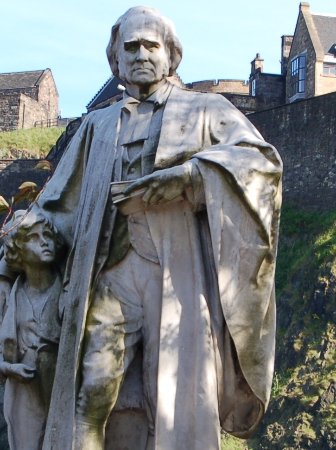
There was a time when the church was at the very heart of poverty relief and the fight against injustice. We see clues to this in the architecture and sites of Edinburgh. Towards the West End of Princes Street we see the imposing statue of Dr Thomas Guthrie. Under one arm he has a Bible while under the other arm a fearful looking ‘ragged child’ looks out. It is like the portrait of Guthrie in the National Portrait Gallery in Queen Street entitled ‘A Mission of Mercy’. He stands at the top of the Lawnmarket patting affectionately one of the many ‘ragged children’ while behind him stands one of the ‘Dram Houses’ that Guthrie so hated. Dr Guthrie’s great legacy, as the statue states, is that he was ‘a friend to the poor and to the oppressed.’ His great friend and mentor, Thomas Chalmers, stands close by in George Street. One of Scotland’s foremost social reformers, Chalmers, like Guthrie, is now an unknown and unrecognised relic from Scotland’s Christian heritage.

IMG_0440

The fathers of the Free Church never saw the false and unbiblical divergence between preaching the gospel and helping the poor as we do today. Largely the Christian church (and the Free Church in particular) have franchised out to the government their responsibilities to love the widow, the orphan, the poor and the stranger. Most Deacons’ Courts have become finance and fabric committees without any serious attempt to deal with the poor around the congregation. Many ministers and elders seem to think the government have largely solved poverty and need through the welfare state so the church no longer has a role. Not unlike the Victorian era, the church has ceased to fight injustice and is no longer the conscience of the nation. We have become part of the establishment rather than seeking to fight against the injustice and corruption of the rich and powerful.

Thankfully, when Guthrie came to Edinburgh from his rural parish in Angus in 1837, he was willing to take the civil and religious establishment head on. Thousands of children were living on the streets of Edinburgh or in squalor. As if this wasn’t bad enough, most of the church not only ignored the situation but some even argued it was God’s will. Like today, rather than investing money in care and welfare, huge amounts of money was spent in prison and punishment with little effect. It was the same in London when Wilberforce took on the slave trade. Some of his fiercest criticism came from the religious establishment. As Metaxas says in his excellent biography of Wilberforce: ‘Many thought God had ordained the poor’s situation, that it was part of the natural order, and that they should therefore be kept where they were, in their misery. To help them was tantamount to shaking one’s fist at God.’

Like Isaiah and Micah, Guthrie saw the connection between worship and social justice (Isaiah 58). The prophet Micah ministered at a time of great corruption and injustice. Israel’s sins ranged from sorcery and idolatry (Micah 5 v 12-14) to deceit and fraudulent dealings (Micah 6 v 10, 11). Justice had broken down particularly in the distribution of land. The land intended for the inheritance of all God’s people was seized by the rich and the powerful (Micah 2 v 1-5 and Numbers 27 v 1-11). God’s people had ceased to be the conscience of the nation and instead had become complicit with the rich and powerful. Micah condemns Judah’s religious leaders for their disregard for justice and truth. He tells them in Micah 6 v 8 ‘He hath showed thee O man, what is good, and what the Lord requires of thee: surely to do justly, and to love mercy, and to humble thyself, to walk with thy God.’

The Hebrew word for justice is mishpat which emphasises the activity of ‘doing justice’. This word comes up over 200 times in the Old Testament. The mishpat or justice of a society in the Bible is based on how certain groups of people were treated. In the Old Testament, this included widows, orphans, the immigrant or the poor. Thus, in Zechariah 7 v 10-11 we read; ‘Thus says the Lord of hosts, render true judgements, show kindness and mercy to one another, do not oppress the widow, the fatherless, the sojourner, or the poor, and let none of you devise evil against another in your heart’. Why should we stand up for the poor? Why should we fight injustice? Because God commands it but also because it is the very character of God. In Psalm 146 v 7-9 we read; …who executes justice [Mishpat] for the oppressed, who gives food to the hungry. The Lord sets the prisoners free; The Lord opens the eyes of the blind. The Lord lifts up those who are bowed down; The Lord loves the righteous. The Lord watches over the sojouners; He upholds the widows and the fatherless, But the way of the wicked he brings to ruin.’ Micah calls on God’s people to practice justice. To stop stealing land, to treat people humanely, and to stop oppressing the widows and orphans.

Even more than that, the people of God are to love mercy. The Hebrew word used in Micah for mercy is hesed – faithful or unfailing love. It is not enough to do justice – we are to delight in doing it. Doing justice and loving mercy is the fruit of walking humbly with God. When we walk with God it means that we come to know him intimately and desire what he loves and desires. The people in Judah had forgotten God and had become self-absorbed. This led to oppression of the poor and a lack of love for the marginalised. People were selfish not loving. But when people walk with God in intimate fellowship Him they are infused with the love of God. They love God and love their neighbour. They love the first and second table of the law.

IMG_0441

Justice and love aren’t just a nice idea, they are the fruit of the gospel. The more we understand of the grace of God, the more we will do justice, and love mercy. We don’t need to decide between preaching the gospel and loving the poor. God asks us to both. When we fight justice, and love the poor it doesn’t dilute the gospel it makes the gospel more attractive, the church more authentic and Christians become like beacons in a dark society. We fulfil the command of James 1 v 27 ‘Religion that is pure and undefiled before God, the Father, is this, to visit orphans and widows in their affliction, and to keep oneself unspotted from the world.’ The gospel calls for activity. We are called to love those have nothing and can offer nothing in return. As Dr Guthrie says ‘Religion does not consist in doctrinal or prophetical speculations; nor lie like a corpse entombed in old dusty confessions. She lives in action, and walks abroad among mankind – calling us to leave our books, to shut our Bibles, to rise from our knees, and go forth with hearts full of love and hands full of charities.’

A wee word with Himself

Last Sunday, I heard two sermons. This is not unusual. Like generations of Lewis folk before me, unless I’m ill or off the island, I go to the searmon in the morning and to the coinneamh at night. The distinction is an historical one because, actually, it’s the same building, same format and – frequently- the same preacher at each service. It is the revered ‘da cheann-latha’, which is unfortunately expressed in English as being ‘out both ends’. And, I know that, to my atheist friends, this is a devotion too far.

I know, because when I’m tired, or below-par, they will tell me to give church a miss. ‘Don’t go to the evening service’, they’ll say. No one ever suggests that I should do less housework (perhaps because they’ve been in my home), or less studying, less going to the cinema, or dog-walking. And I know why.

They think, as I once did myself, that all that church-going must be a strain. Surely I need to switch off from it. Wouldn’t I love to break the routine? Don’t those two trips from Tolsta to Stornoway get tiring, and tiresome? And here is where I wish that I had a better way with words. These Sundays are far from tiring; they are wells of living water which irrigate the whole week. I’m not going because I have to, or am expected to, or would be talked about if I wasn’t there. Nor is there a black-hatted elder keeping a sederunt book (and if there was, it jolly well wouldn’t have a Latin name anyway).

I want to be able to say why I willingly leave the comfort of my own home to get in the car and drive for 20 minutes, twice a day, but I just haven’t the words. Only, it occurs to me that there, right there, is the reason: I am NOT leaving the comfort of my own home. In fact, much of what is attractive in the gospel of Christ is its familiarity, it’s very home-ness. And for me, it can be summed up in three precious phrases.

In the coinneamh last Sunday, we heard how Jesus deals with us in our trials; He says – as he said to Peter – ‘this is for me and for you’. This, in other words, you do not have to face alone because I will go through it with you. And He does.

These were such beautiful words, so simple and yet conveying so much of the Saviour’s love, that they caused me to think of other words that bring Him near. A few months ago now, in the searmon, the minister spoke of the disciples, frightened by a storm at sea, until they were joined by Jesus. ‘It’s myself’, He said to them. Intimate, familiar and reassuring: ‘it’s myself’. The storm hadn’t ceased, but it didn’t matter because He was there, Himself, Myself; and He might have added, of the storm, ‘it’s for Me and for you’.

My own father is the reason that I had a positive image of who God the Father might be. Sadly, not everyone understands the concept of a benign, loving paternal figure, but I was blessed in that respect. One of my abiding memories of him is how he used to carry me, as a child, down our steep staran in the winter frost. Safe in his arms, I knew nothing bad would happen to me.
When my father died, and four years later when my husband did, the minister came to our home, the same minister both times. And when he suggested that he might pray, on each occasion, he used the same lovely phrase, ‘we’ll just have a wee word’. God is so close by that this intimacy is not just possible, but somehow right.

One of the worst pieces of advice I was given after my husband died was not to ‘over-spiritualise things’. I think our tendency is, rather, to under-spiritualise. When my friends see that I’m tired, they mean to be kind and to show concern by telling me to take a break from church. They see the outward ritual, but not the inward refreshing. I can’t make them see that it wouldn’t be a rest, but a punishment to stay at home. And when I try to give a reason for the hope that is in me, they smile and say, ‘yes, but we need proof’, as though I’m a credulous child. How can I bridge that divide? Is there a way to tell them, in words that will make them understand, that I have proof? How I wish there was. Is this enough:

When I am about to be overwhelmed by fear, or sadness, or fatigue, He says, ‘this is for me and for you’; when I feel that I am alone, or abandoned, He says, ‘it’s Myself’, and whenever I need Him, I can simply say, ‘I need a wee word‘. He is not far away, but very near, and very familiar. Like home.

Are you now, or have you ever been a member of the Free Church?

Our forefathers used to have a blessing for everything. Look through the amazing resource that is ‘Carmina Gadelica’, and you will see blessings for birth and for baptism, yes; but also blessings for milking the cow and for smooring the fire. I have a woodburner myself, but I can still appreciate the beauty of the words. And any maw who has ever experienced the searing pain of smoor in the eye can surely see the need of such a verse.

The point is,  spirituality was woven into their lives. God was their God all the time. These blessings for milking and smooring, and all the tasks that lay in between, spun a thread of faith through each successive day. But then, they were poor, ignorant souls and there was no Equalities Act to tell them that they shouldn’t pray near the cow without first obtaining her permission. After all, what if the cow was a Hindu? No, in their uneducated bliss, they committed their days to God as naturally as breathing. He was with them in the mundane tasks, as well as those which elevate life beyond the ordinary. And in this, they were simply living as closely to His pattern as any pastoral people outside of Eden ever could.

Now, we follow an artificially demarcated week, which would have been utterly alien to our forefathers. God’s time and theirs knitted together; but we have allowed those threads to loosen. And the tricky thing about loose threads is that there will always be someone to worry at them until they fray completely.

Individual Christians are, of course, responsible for their own walk with God, and for guarding against attack. To some, perhaps ‘attack’ evokes images of countries where Christians are persecuted for their faith, where they must worship in secret, in fear of their lives. But I’m not talking of that kind of onslaught; I’m talking of the insidious creep of a worldview which thinks itself accepting, but is highly selective in what it will countenance.

1 Timothy reminds us how dangerous false teaching is. In fact, 1 Timothy could have been written for the very age that we’re living in, when it seems that the only real crime is saying that some forms of human behaviour are simply . . . wrong. To be a Christian in this society means taking a stand for what you believe, when what you believe is foolishness to everyone around you.

Some of the candidates for election to seats in Comhairle nan Eilean are Christians. Then again, so are some of the electorate. I have seen requests for those standing, who have committed their lives to Christ, to be upfront about this with voters. As far as I’m aware, they have not attempted to hide their beliefs, and so I find these demands extraordinary. What particular threat to democracy is posed by a Christian councillor that is not also posed by a secularist one? Or a feminist one? Or a socialist, tea-drinking, banjo-playing one?

By compiling lists of who the Christians are among our politicians, what are we hoping to achieve? Is it not enough to demand the impossible, that they separate their Christianity from their decision-making? We are now going down an even darker road, it seems to me, and one that has been traveled by others before us with no good result. Perhaps the question posed should be modelled along McCarthyist lines: ‘are you now or have you ever been a member of the Free Church?’ Luckily, though, the right to be a councillor AND a Christian is enshrined in the 2010 Equalities Act, which reminds those of us impolite enough to need reminding, that we mustn’t discriminate against people on the grounds of adherence or non-adherence to a particular faith.

Simply ‘allowing’ the election of practicing Christians is not sufficient, however. There has to be an acceptance that they will be followers of Christ, even when they are voting in the Comhairle chamber; true equality understands and respects this. In return, I am sure that they will serve in accordance with these words from Carmina Gadelica’s blessing for kindling the fire:

God, kindle Thou in my heart within


A flame of love to my neighbour,


To my foe, to my friend, to my kindred all,


To the brave, to the knave, to the thrall.

A cup of cold water – but in whose name?

‘I never witnessed such countenances: starvation on many faces, the children with their melancholy looks, big-looking knees, shrivelled legs, hollow eyes, swollen-like bellies. God help them, I never did witness such wretchedness.’

Need is so familiar that we are almost inured to it. We have come a long way from the first shock of the Ethiopian famine in 1984 and the harrowing images it brought into our homes. For a time, we were unable to ignore poverty and suffering, and people’s response was immediate and heartfelt.

Except, these words do not describe the Ethiopian famine of 1984; they are actually an account of the Highland famine of 1845 – 55. More specifically, they are the eyewitness account of the Rev. Norman MacLeod, who was crossing the ford at Gramasdail in Uist, when he saw the destitute population, gathering cockles for their food. His heart was clearly moved, and he appealed to the Creator to take them into His care.

If you do not believe in God, such petitions seem void. I know that the Western Isles Secular Society (or is it Western Isles Non-believers – mo chreach, they have that many denominations, it’s hard to keep up), view prayer as an alternative to real help. Atheists think that to say, ‘I’m praying for you’ is tantamount to telling people that you are unwilling to do anything practical for them.

They say that . . . and then they also object to Christians being involved in charitable works. Groups like Hebrides Alpha should not be able to request a Christian commitment from its employees, palliative care should not be offered by a home founded by Christians; whatever next? It must be difficult, of course, carving out an identity for yourself purely in terms of what you do not believe. Such a negative position must leave you contradicting yourself frequently. I mean, telling Christians that they can’t interfere and impose their worldview on others seems to me a little bit like . . . well, interfering and imposing your worldview on others.

Charity, though, without Christians? Etymologically, the very word derives from one meaning, ‘Christian love’. This is not cold, dutiful alms-giving, but obedience to the Saviour. For He it was who said that the poor would always be with us. I don’t for one minute believe that this was meant as a discouragement, that we should resign ourselves to the omnipresence of grinding poverty. After all, He followed it up with something else – he added that we would not always have Him with us.

So, what was he saying? I believe that it was a reminder that the poor and needy are His proxy in one important sense: those who love the Saviour would not see Him suffer, would not see Him hunger, or thirst. Neither can a Christian look upon need in others, and not be moved in their heart to help. It is their privilege to help, and no man has the right to stand in their way.

The Rev. Norman Macleod appealed to the Almighty for the famine victims in the Highlands and Islands, and then he appealed to the government. Still in its infancy, the Free Church rapidly identified those most in need of food aid, able to do so because its ministers were so close to the congregations they served. ‘Breadalbane’, the boat they had purchased to circumvent problems with pulpit supply and availability of land for new churches, was pressed into service, carrying meal to the hungry corners of the region. Not one of those destitute people, I am certain, questioned the motives of the church in bringing them assistance.

In our own day, the shining example of Christian love in this regard is the Bethesda Hospice. Founded by Christians, built by charitable giving, it offers compassion, kindness, dignity – and, yes, love – to those in the last hours of their lives. They cared for my terminally-ill husband as though they were caring for the body of his Saviour. But they would care for anyone just the same. That is, after all, the essence of charity.

I recently sat in our hall in Stornoway Free Church, and listened to a presentation by Christians Against Poverty. There are people in this country right now who have to choose between eating and staying warm. We heard of a couple who ate only twice a week so that their children could have a meal every day. CAP is doing something about that. Have we honestly reached a point where people believe that work like this should be curtailed simply because it carries the label, ‘Christian’? And if we are reaching that point, what is secularism going to be doing to supply the deficiency? Or are Christians expected to carry on being charitable, and to be complicit in removing their Saviour’s name from their efforts,  lest He offend?

I pity anyone who falls for the argument that charity should not be allowed in the name of Christ. There is an agenda being pushed all the time, however, that aims to persuade us of just that. They tell us that it is our right not to have Christ’s presence insisted upon; they try to convince us that it is wrong for Christians to interfere in good works. God forbid that they should succeed. If they do, we might well say then of the secularists themselves, ‘I never did witness such wretchedness’.